Article Summary
A person in India can generally represent themselves in court without hiring a lawyer, commonly known as appearing party-in-person. However, self-representation requires understanding court procedures, filing requirements, limitation periods, evidence rules, drafting, and oral arguments. While straightforward matters may sometimes be handled independently, complex civil, criminal, commercial, or constitutional cases can involve significant procedural and legal challenges. A party choosing to appear personally must still comply with the same applicable laws, court rules, deadlines, and procedural requirements.
Can you represent yourself in Indian courts without a lawyer? Understand Party in Person rules for Supreme Court, High Court, family court, civil and criminal matters, procedure, risks, and legal rights in India.
NEW DELHI: Many people believe that you cannot enter an Indian court or fight a case unless you hire a lawyer.
That is not entirely true.
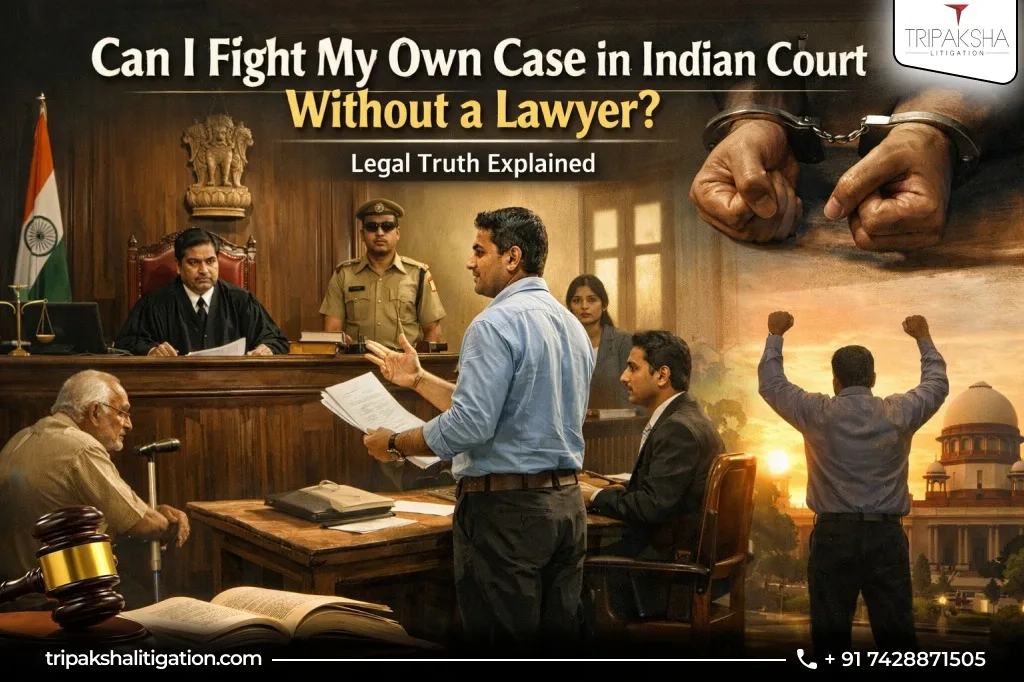
Indian law allows a person to appear in court and handle his own matter in many situations. This is commonly known as appearing as a Party in Person.
However, just because the law permits it does not mean the process is simple.
Courts follow procedure, timelines, documentation rules, and legal discipline.
Judges expect litigants to present their case properly, whether represented by a lawyer or not.
So yes, you can fight your own case in many Indian courts—but it should be a well-thought-out decision, not an emotional reaction or cost-cutting shortcut.
Meaning of “Party in Person”
A Party in Person refers to a litigant who appears before the court and conducts his own case without appointing an advocate.
This concept is recognized across:
- Supreme Court
- High Courts
- Civil Courts
- Criminal Courts
- Family Courts
- Consumer Forums and Tribunals (subject to procedural rules)
The court deals directly with the litigant, who assumes full responsibility for pleadings, evidence, and arguments.
Legal Foundation for Self-Representation
Constitutional Backing
- Article 21: Access to justice is an essential part of life and personal liberty.
- Article 14: Equality before law ensures no discrimination in access to courts.
- Article 39A: Directs equal justice and legal aid.
These provisions collectively establish that access to courts is a legal and fundamental right, not dependent on hiring legal representation.
Statutory Recognition
The Advocates Act, 1961 (Section 32): This is the primary statutory basis, empowering any court or tribunal to allow a person not enrolled as an advocate to appear and represent their case.
Civil Proceedings
Under Order III Rule 1 of the Code of Civil Procedure, 1908, a party may:
- Appear in person, or
- Through a recognized agent, or
- Through a pleader
This explicitly validates personal appearance.
Criminal Proceedings
Under Section 303 of the Code of Criminal Procedure (now mirrored under Section 340 BNSS), an accused has the right to be defended by a lawyer of choice. It is not a mandatory obligation.
However, procedural compliance remains strict, especially during trial and evidence stages.
Family Court Proceedings
Under Section 13 of the Family Courts Act, 1984, legal representation is not automatic. Courts often prefer direct interaction with parties.
This makes family courts one of the most practical forums for self-representation.
Supreme Court Practice
The Supreme Court allows filing as a Petitioner in Person, subject to procedural scrutiny and registry compliance.
Appearance Before the Supreme Court
Filing and arguing in the Supreme Court without a lawyer is legally permissible but procedurally demanding.
Requirements include:
- Structured petition (SLP/Writ)
- Synopsis and list of dates
- Proper affidavit
- Compilation of annexures
- Removal of registry defects
- Personal presence during hearings
The Court maintains a Petitioner in Person Cell to screen such filings.
In practice, technical deficiencies often result in dismissal at the threshold.
Practice in High Courts
High Courts generally permit litigants to appear in person in:
- Writ petitions
- Bail matters (subject to court discretion)
- Civil revisions and appeals
- Contempt proceedings
Certain High Courts may require:
- Formal application for self-representation
- Identity verification
- Declaration of appearing as Party in Person
Proceedings in Family Courts
Family courts are structurally more accommodating for litigants appearing personally.
Common matters:
- Divorce
- Maintenance
- Child custody
- Visitation disputes
The focus is more on facts, conduct, and circumstances rather than complex legal interpretation. Courts often engage directly with parties, making this forum comparatively accessible.
Criminal Matters: Scope and Limitations
As an Accused
Self-representation is legally permissible but operationally risky, especially in:
- Trial proceedings
- Cross-examination
- Evidence appreciation
As a Complainant
In private complaints (e.g., cheque bounce matters), personal prosecution is common.
Critical Limitation
Procedural law, evidence rules, and burden of proof remain unchanged. Courts do not relax legal standards for unrepresented litigants.
Key Judicial Precedents
- Harishankar Rastogi v. Girdhari Sharma (1978) – Supreme Court of India
The Court acknowledged the right of a party to appear personally, while clarifying that representation by non-advocates is subject to judicial control.
Principle: Personal appearance is a recognized right; unauthorized representation is not.
- T.C. Mathai v. District & Sessions Judge (1999) – Supreme Court
The Court held that a non-advocate cannot plead on behalf of another person unless specifically permitted.
Principle: Distinction between self-representation and third-party representation.
- A.S. Mohammed Rafi v. State of Tamil Nadu (2011) – Supreme Court
The Court emphasized that no external body can restrict legal representation.
Relevance: Reinforces the broader principle of access to justice and fair hearing.
Procedural Roadmap for Self-Representation
Step 1: Determine Jurisdiction
Identify the correct court based on subject matter and territorial limits.
Step 2: Draft Pleadings
Include:
- Facts
- Cause of action
- Legal grounds
- Relief sought
Step 3: Compile Documents
Attach all relevant evidence and records.
Step 4: File as Party in Person
No vakalatnama required. Clearly state self-representation.
Step 5: Attend Hearings
Maintain presence or seek exemption where permissible.
Step 6: Lead Evidence
File affidavits, documents, and examine witnesses.
Step 7: Final Arguments
Summarize facts, law, and relief sought.
Courtroom Discipline for Litigants
- Address the court formally
- Maintain structured documentation
- Avoid emotional submissions
- Stick to relevant facts
- Prepare written notes
- Do not interrupt proceedings
- Respect procedural timelines
Courtroom conduct directly impacts judicial perception.
Risks Involved
Procedural Errors: Incorrect drafting can lead to outright dismissal.
Limitation Issues: Delay may permanently bar the claim.
Evidence Mismanagement: Improper filing or marking of documents weakens the case.
Emotional Bias: Personal involvement often leads to over-argumentation.
Legal Imbalance: Opposite party may engage experienced counsel.
Situations Where Legal Representation Is Advisable
- Serious criminal charges
- Complex civil disputes involving high-value property
- Constitutional matters
- Supreme Court litigation
- Technical domains such as taxation or corporate law
- Cases involving extensive cross-examination
In such matters, professional representation is often decisive.
Common Misconceptions
- Courts do not reject cases merely due to absence of a lawyer.
- Lawyers are not mandatory in family courts.
- Friends or relatives cannot argue as a matter of right.
- Self-representation does not guarantee cost savings if mishandled.
Is Fighting Your Own Case the Right Decision?
Indian law permits self-representation, but it does not simplify the legal system for those who choose it. Courts expect procedural compliance regardless of representation status.
The decision to appear personally must be based on:
- Nature of the dispute
- Legal complexity
- Stakes involved
- Ability to handle procedure
Access to justice exists. Effective use of that access depends on legal awareness and discipline.
CONCLUSION
Self-representation in Indian courts is a lawful option, but it should never be mistaken for an easy alternative to professional legal assistance. The right to appear in person gives a litigant control over his own case, but it also places the full burden of drafting, procedure, evidence, arguments, and courtroom conduct on his shoulders.
When approached with preparation, legal understanding, and discipline, appearing as a Party in Person can be effective in the right matters. But when chosen out of anger, overconfidence, or an attempt to save costs without understanding the process, it can seriously weaken even a strong case.
The real question is not whether you can fight your own case. The real question is whether you are equipped to do it properly. In litigation, strategy matters more than ego, and knowledge matters more than control.
FAQs
- Can a divorce petition be filed without a lawyer in India?
Yes. A person can file and pursue a divorce case personally in Family Court, subject to proper drafting, documentation, and procedural compliance.
- Can an accused person argue his own criminal case?
Yes. An accused may defend himself in court, but criminal matters involve technical procedure and evidence law, so self-representation can be risky.
- Is appearance in High Court without an advocate allowed?
Yes. High Courts may permit a litigant to appear as a Party in Person, subject to the rules and discretion of that particular court.
- Can a friend or family member argue a case on behalf of a litigant?
Generally no. A third person cannot automatically argue in court unless specifically permitted by the court in exceptional circumstances.
- Are maintenance or family court matters suitable for self-representation?
In many cases, yes. Family Courts often interact directly with parties, making maintenance, custody, and matrimonial disputes more suitable for personal appearance when handled properly.