Article Summary
A false FIR can affect a person’s career, employment prospects, professional reputation, background verification, and opportunities for government or regulated jobs, even before the criminal case reaches its final outcome. However, registration of an FIR does not establish guilt. Depending on the circumstances, an accused person may seek anticipatory or regular bail, quashing of the FIR, discharge, or other appropriate legal remedies. Keeping court orders and case records is also important when responding accurately to employment or background-verification requirements.
False FIRs can destroy careers before trial even begins. Know the legal remedies under BNSS, BNS and Supreme Court case law.
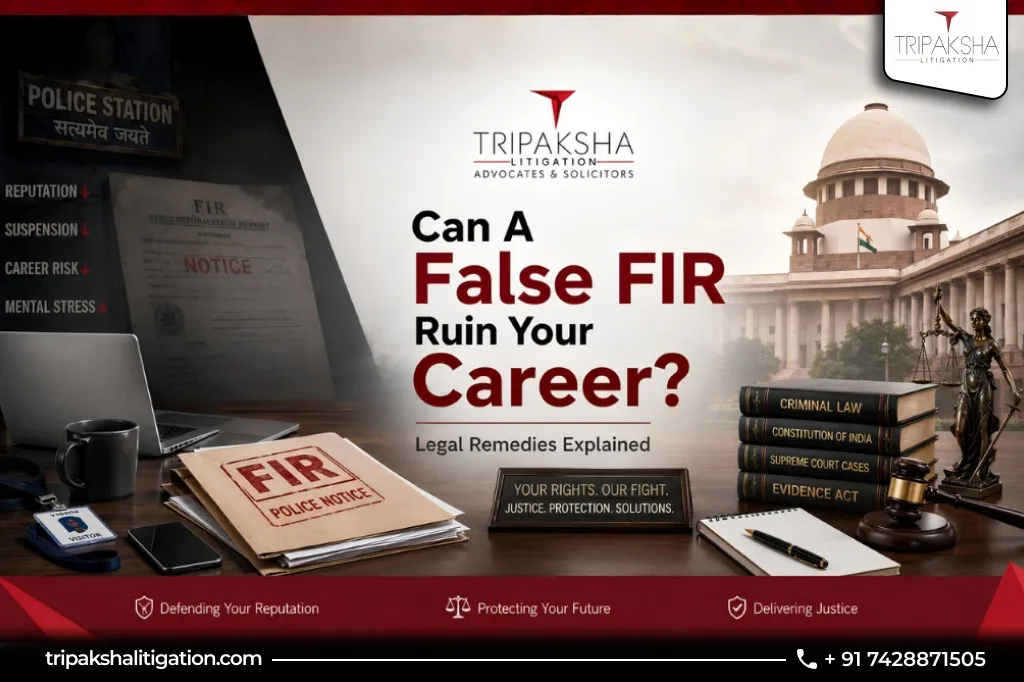
NEW DELHI: A false FIR can damage much more than your legal record. It can affect your job, reputation, business, passport verification, family life, mental health, and future opportunities. In today’s digital world, allegations spread quickly, while the truth often takes years to emerge through the legal process.
The most important thing to understand is this: an FIR is not proof of guilt. It is merely the beginning of an investigation. However, if you do not act quickly and strategically, the consequences of a false FIR can become severe.
What Is An FIR Under Indian Law?
An FIR (First Information Report) is recorded when information regarding a cognizable offence is given to the police.
Under Section 173 of the Bharatiya Nagarik Suraksha Sanhita, 2023 (BNSS), police can register an FIR and begin investigation into cognizable offences.
The Supreme Court in Lalita Kumari v. Government of Uttar Pradesh held that registration of an FIR is generally mandatory when information discloses a cognizable offence.
However, registration of an FIR does not mean the allegations are true. The investigation exists precisely to determine whether there is evidence supporting the complaint.
Can A False FIR Affect Your Career?
Unfortunately, yes.
Even before a court determines the truth, a false FIR may create serious professional difficulties.
Possible Career Consequences
- Employer background verification issues
- Government job complications
- Police verification concerns
- Suspension from service
- Professional licence scrutiny
- Business reputation damage
- Passport and visa difficulties
- Loss of promotions and opportunities
The Supreme Court in Avtar Singh v. Union of India recognised that criminal cases and criminal antecedents may affect employment decisions depending on the facts of each case.
This is why a false FIR should never be ignored.
FIR Is Not Conviction
Many people wrongly assume that once an FIR is registered, the accused has already lost the case.
The criminal process generally follows this sequence:
- FIR Registration
- Investigation
- Notice or Arrest
- Bail Proceedings
- Chargesheet or Closure Report
- Trial
- Acquittal or Conviction
An accused person remains presumed innocent unless guilt is proven in accordance with law.
What Should You Do Immediately After A False FIR?
The first few days are critical.
- Do Not Panic: Emotional decisions often cause greater damage than the FIR itself.
- Preserve All Evidence: Collect and preserve-
- WhatsApp chats
- Emails
- Call recordings
- CCTV footage
- Social media posts
- Photographs
- Travel records
- Bank transactions
- Witness details
- Consult A Criminal Lawyer Immediately: Early legal advice often prevents unnecessary mistakes.
- Cooperate With The Investigation: Avoid confrontation with police authorities.
- Avoid Public Arguments On Social Media: Online statements frequently become evidence later.
Anticipatory Bail: Protecting Yourself From Arrest
If there is a reasonable apprehension of arrest, anticipatory bail may be available.
Relevant Law
- Section 482 BNSS
Anticipatory bail protects a person from being taken into custody before arrest.
Important Case
Arnesh Kumar v. State of Bihar
The Supreme Court held that arrest should not be automatic merely because an FIR has been registered.
The judgment is particularly important in matrimonial and family disputes where arrests were often made mechanically.
Can A False FIR Be Quashed?
Yes. Where allegations are false, malicious, absurd, or legally unsustainable, the High Court may exercise its powers to quash the FIR.
Relevant Law
- Section 528 BNSS
- Article 226 of the Constitution
Landmark Case
State of Haryana v. Bhajan Lal
The Supreme Court identified categories where criminal proceedings can be quashed, including:
- No offence disclosed
- Malicious prosecution
- Abuse of legal process
- Civil disputes disguised as criminal cases
- Allegations that are inherently improbable
Important Limitation
Quashing is not automatic.
The Supreme Court in Neeharika Infrastructure v. State of Maharashtra cautioned that courts should interfere only in appropriate cases.
False Matrimonial FIRs And Family Disputes
One of the most common areas of alleged misuse of criminal law involves matrimonial disputes.
In many cases, allegations are made not only against the husband but also against:
- Parents
- Married sisters
- Brothers
- Elderly relatives
- Family members living separately
The Supreme Court has repeatedly expressed concern regarding omnibus allegations against relatives.
Important Judgments
- Preeti Gupta v. State of Jharkhand
- Geeta Mehrotra v. State of U.P.
- Kahkashan Kausar v. State of Bihar
These judgments emphasise that vague and general allegations against family members cannot automatically justify criminal prosecution.
False Promise To Marry And Relationship Cases
Not every failed relationship amounts to a criminal offence.
The Supreme Court in Pramod Suryabhan Pawar v. State of Maharashtra clarified that criminal liability depends on whether the promise to marry was false from the beginning and was used solely to obtain consent.
Courts examine:
- Intention at the time of the promise
- Conduct of the parties
- Duration of the relationship
- Surrounding circumstances
- Available evidence
Every breakup is not a crime.
How To Build A Strong Defence
Courts decide cases on evidence, not emotions.
Useful Evidence
- Mobile chats
- Emails
- Audio recordings
- CCTV footage
- GPS records
- Financial transactions
- Medical documents
- Witness testimony
- Social media communications
Digital Evidence
Electronic records are recognised under the Bharatiya Sakshya Adhiniyam, 2023 and often become decisive in criminal litigation.
Many false allegations collapse when digital records tell a different story.
Relevant Provisions Under Bharatiya Nyaya Sanhita, 2023
False Information To Public Servant
- Section 217 BNS
False Evidence
- Section 227 BNS
- Section 228 BNS
False Criminal Charge
- Section 248 BNS
Defamation
- Section 356 BNS
However, acquittal alone does not automatically prove that the complaint was false. Courts generally require evidence showing deliberate falsehood or malicious intent.
Can You Claim Compensation?
In exceptional cases, yes.
Depending on the facts, remedies may include:
- Defamation proceedings
- Civil damages
- Malicious prosecution claims
- Constitutional compensation in rare cases
Important Cases
- Rudul Sah v. State of Bihar
- Bhim Singh v. State of Jammu & Kashmir
- Nilabati Behera v. State of Orissa
Compensation claims are highly fact-specific and usually require strong evidence of wrongful action.
Government Jobs, Passport Verification And Police Clearance
Many people worry that a false FIR will permanently destroy their future.
That is not necessarily true.
Authorities often consider:
- Nature of allegations
- Stage of proceedings
- Outcome of the case
- Acquittal or discharge
- Conduct of the applicant
What often causes more damage than the FIR itself is suppression of information.
Always make legally accurate disclosures where required.
Common Mistakes To Avoid
If a false FIR is filed against you, avoid these mistakes:
- Do not abscond
- Do not threaten the complainant
- Do not destroy evidence
- Do not delete chats
- Do not sign documents under pressure
- Do not make reckless online allegations
- Do not ignore police notices
- Do not rely solely on verbal assurances
A disciplined legal strategy is always more effective than emotional reactions.
CONCLUSION
A false FIR can undoubtedly damage a person’s career, reputation, finances, and peace of mind. However, an FIR is not a conviction, and Indian law provides several safeguards for innocent individuals.
Anticipatory bail, regular bail, FIR quashing, documentary evidence, digital records, and legal action against malicious complainants are all important remedies available under the law.
The biggest mistake most people make is waiting. The strongest defence usually begins immediately after learning about the FIR. Timely legal action, proper evidence preservation, and a well-planned litigation strategy can often prevent a false allegation from becoming a lifelong burden.
The law may not stop every false accusation from being filed, but it does provide remedies to challenge false allegations and protect both liberty and reputation.
FAQs
- Can a false FIR affect my job or career?
Yes. A false FIR can impact background verification, government employment, promotions, business opportunities, and professional reputation. - Can I get anticipatory bail if a false FIR is filed against me?
Yes. If there is a risk of arrest, you can seek anticipatory bail under Section 482 BNSS to protect your liberty. - Can the High Court quash a false FIR?
Yes. The High Court can quash an FIR if the allegations are false, malicious, or do not disclose any offence. - Can I take action against the person who filed a false FIR?
Yes. In appropriate cases, you may pursue remedies for false charges, false evidence, defamation, or malicious prosecution. - What should I do immediately after a false FIR is registered?
Preserve all evidence, avoid panic, and consult a lawyer immediately to protect your rights and build your defence.