Article Summary
A Supreme Court Transfer Petition should be supported by proper documents and credible evidence, not merely claims of inconvenience or hardship. For civil or matrimonial inter-State transfers, important documents include the petition, supporting affidavit, pending case papers, relevant court orders, annexures, Vakalatnama, residence proof, and evidence supporting medical, financial, child-care, safety, or connected-case grounds. Proper indexing, translations, court fees, and other Registry requirements are also important to avoid filing defects and delays.
A practical 2026 guide to the documents, annexures, affidavits and evidence you should keep ready before filing a transfer petition
NEW DELHI: A weak Transfer Petition in the Supreme Court is often not weak because the petitioner has no hardship. It is weak because the hardship is narrated but not documented.
Saying, “I live far away”, “I have a child”, “I cannot afford repeated travel” or “other cases are already pending in my city” is only an allegation until the record supports it.
This distinction matters.
A Supreme Court Transfer Petition is not decided on sympathy alone. The petition must identify the proceeding sought to be transferred, the court where it is pending, the court to which transfer is sought, the grounds for transfer and the material supporting those grounds.
For civil proceedings, Section 25 of the Code of Civil Procedure, 1908 empowers the Supreme Court, on an application by a party, to transfer a suit, appeal or other proceeding from a High Court or Civil Court in one State to a High Court or Civil Court in another State when transfer is expedient for the ends of justice. Section 25 expressly requires the application to be supported by an affidavit.
So before asking what argument should be made, ask the more important question:
What document proves that argument?
LEGAL BASIS FOR A SUPREME COURT TRANSFER PETITION
A civil or matrimonial Transfer Petition before the Supreme Court is ordinarily filed under Section 25 CPC read with Order XLI of the Supreme Court Rules, 2013. The Supreme Court continues to publish the Supreme Court Rules, 2013 together with subsequent amendments on its official website, and recent 2026 Registry records continue to describe Section 25 transfer petitions as being filed read with Order XLI.
Do not confuse an inter-State transfer with a transfer between courts within the jurisdiction of the same High Court. Section 24 CPC gives the High Court and District Court powers of transfer within their statutory jurisdiction. The Supreme Court in Durgesh Sharma v. Jayshree, (2008) 9 SCC 648 dealt with this jurisdictional distinction and the limits of a High Court’s power to transfer proceedings to a court outside its territorial jurisdiction.
For criminal proceedings, the current statutory provision is Section 446 of the Bharatiya Nagarik Suraksha Sanhita, 2023. The Supreme Court’s current case-category system itself identifies criminal transfer petitions under Section 406 CrPC/Section 446 BNSS, accounting for legacy and transitional matters.
Do not copy a civil Transfer Petition checklist blindly into a criminal matter.
DOCUMENTS REQUIRED FOR TRANSFER PETITION IN SUPREME COURT
There is an important distinction between filing documents and evidence supporting the grounds for transfer.
Not every medical report, bank statement or school certificate is compulsory in every case. But if you rely upon illness, financial hardship or responsibility for a minor child, the absence of supporting documents can substantially weaken the factual foundation of that ground.
THE CORE FILING CHECKLIST
- Transfer Petition containing the proper cause title, particulars of the pending proceeding, the transferor court, proposed transferee court, factual grounds and precise prayer for transfer.
- Synopsis and List of Dates setting out the matrimonial or litigation history chronologically and allowing the Court to understand the dispute without searching through every annexure.
- Supporting affidavit verifying the factual assertions in the petition. Section 25 CPC itself requires the transfer application to be supported by an affidavit.
- Copy of the proceeding sought to be transferred, such as the divorce petition, matrimonial petition, civil proceeding or other principal pleading pending before the transferor court.
- Relevant orders and case documents, particularly summons/notices, important interim orders, orders relating to appearance and any document necessary to establish the present stage of the proceeding.
- Properly marked annexures containing every document specifically relied upon in the petition. The Supreme Court Registry’s scrutiny checklist requires pleadings and accompanying documents to be clear and legible, and generally insists upon proper indexing and orderly annexures.
- Vakalatnama and Memorandum of Appearance, where the petitioner is represented through an Advocate-on-Record. Under the Supreme Court Rules, an Advocate-on-Record acts and files for the party, and the Supreme Court has reiterated the requirements concerning execution and acceptance of the Vakalatnama.
- Index, filing particulars, Listing Proforma and prescribed court fee, as applicable. The Supreme Court’s current Registry checklist expressly checks court fee, signatures, party particulars, affidavit, Vakalatnama and Listing Proforma at scrutiny.
- Translation or appropriate exemption application, where an annexure contains vernacular material without the required English translation. This is also specifically checked by the Registry.
DOCUMENTS TO PROVE WHERE YOU ACTUALLY LIVE
Residence is routinely pleaded in matrimonial transfer matters. But merely typing a new address in the petition does not establish the circumstances in which you are living there.
Depending upon the facts, useful proof of residence for a Transfer Petition may include a rent agreement, employment record, utility or official correspondence, address-bearing identity document or other reliable contemporary material.
This becomes especially important where one side disputes the petitioner’s claim that he or she has permanently shifted to another city.
A court should not have to guess whether your stated residence is genuine.
DOCUMENTS FOR CHILD-CARE AND CUSTODY HARDSHIP
A petitioner who says that repeated travel is difficult because a minor child is in his or her care should consider placing material showing that responsibility.
Depending upon the case, this may include the child’s birth record, school documents, custody or visitation orders, medical papers or records showing that the child ordinarily resides with the petitioner.
The document should have a purpose. Do not dump an entire child’s personal history into a court file merely to increase the number of annexures.
Relevant evidence is useful. Paper volume is not evidence.
MEDICAL DOCUMENTS: DO NOT JUST WRITE “I AM UNWELL”
This is one of the clearest lessons from Anindita Das v. Srijit Das, (2006) 9 SCC 197.
While considering the plea of ill-health, the Supreme Court noted:
“Except for stating that her health is not good, no particulars are given.”
The transfer petitions were considered on their own facts rather than on an assumption that transfer must automatically follow merely because the petitioner was the wife.
That one observation explains why vague medical grounds are dangerous.
If illness genuinely affects travel, consider filing recent medical reports, prescriptions, treatment records or medical advice which actually demonstrates the nature of the condition and its effect upon travel.
A disease name without context proves very little.
FINANCIAL HARDSHIP MUST ALSO BE PROVABLE
If the petition says that repeated inter-State travel, accommodation and litigation expenses are financially oppressive, the Court should be given a factual basis for that assertion.
Depending upon what is pleaded, relevant material may include salary records, evidence of unemployment, income-tax records, bank records, maintenance orders or other documents establishing the actual financial position.
This cuts both ways.
A husband should not be presumed financially unlimited merely because he is employed. A wife should not be presumed financially incapable merely because she seeks transfer. Section 25 CPC does not create a gender-exclusive remedy. The statutory test is whether transfer is expedient for the ends of justice.
CONNECTED CASES CAN BE VERY IMPORTANT
If divorce, maintenance, custody, criminal or other connected matrimonial proceedings are already pending in the proposed transferee city, annex their relevant pleadings, case details or orders.
Do not merely write, “many cases are pending here.”
Give the case number, court, parties, nature of proceeding and present status.
In the case of N.C.V. Aishwarya v. A.S. Saravana Karthik Sha, 2022 SCC OnLine SC 1199, the Supreme Court considered factors including the parties’ economic position and surrounding matrimonial circumstances, and ultimately directed transfer while also directing that connected proceedings be clubbed before the Family Court at Chennai.
The practical lesson is simple: if connected litigation forms part of your transfer argument, put that litigation on record.
SAFETY OR THREAT GROUNDS REQUIRE MORE THAN FEAR IN WORDS
If personal safety is genuinely relied upon, preserve the contemporaneous material.
That may include police complaints, FIRs where relevant, protection orders, previous court orders or legally usable communications relating to the alleged threats.
But do not manufacture a safety ground merely because it sounds stronger than inconvenience.A false or exaggerated allegation can damage the credibility of the entire Transfer Petition.
SHOULD YOU FILE A SEPARATE STAY APPLICATION?
Yes, where interim protection against continuation of the original proceedings is actually required, the relief should be specifically sought through the appropriate Interlocutory Application for stay/interim relief.
Do not assume that simply filing a Transfer Petition automatically freezes the Family Court or other proceeding.
The Supreme Court maintains separate IA categories for grant of interim relief, ex-parte ad-interim relief and taking documents on record; actual Supreme Court transfer-petition cause lists also show stay applications being filed separately with Transfer Petitions.
If the next hearing before the original court is imminent, this becomes particularly important.
WHAT THE SUPREME COURT REGISTRY CAN OBJECT TO
Many litigants prepare only for the Bench. They forget the Registry.
The Supreme Court’s filing scrutiny presently checks matters such as prescribed court fee, signatures of the AOR or party-in-person, correct party details, supporting affidavit, translation of vernacular material, proper Vakalatnama, Listing Proforma and legibility of the papers. The advocate’s checklist also stresses correct pagination, indexing and proper filing of annexures.
A Registry defect does not mean that the Transfer Petition has failed on merits.
It does mean that avoidable drafting and document mistakes can delay registration and listing.
A good Transfer Petition therefore has to survive two tests: Registry scrutiny first, judicial scrutiny next.
THE BIGGEST DOCUMENT MISTAKES I SEE IN TRANSFER PETITIONS
The first is annexing documents without explaining their relevance.
The second is making a strong factual allegation but annexing nothing to establish it.
The third is hiding an inconvenient fact on the assumption that the other side will not bring it before the Supreme Court.
The fourth is using generic grounds copied from another matrimonial case.
And the fifth is treating the Transfer Petition as though the applicant’s gender itself is a ground for transfer.
It is not.
There may be established jurisprudential considerations regarding the difficulties faced by a spouse, children, finances, travel and connected proceedings. But a lawyer should still present the actual comparative hardship of both parties rather than asking for an automatic result.
FINAL FREE TRANSFER PETITION DOCUMENT CHECKLIST
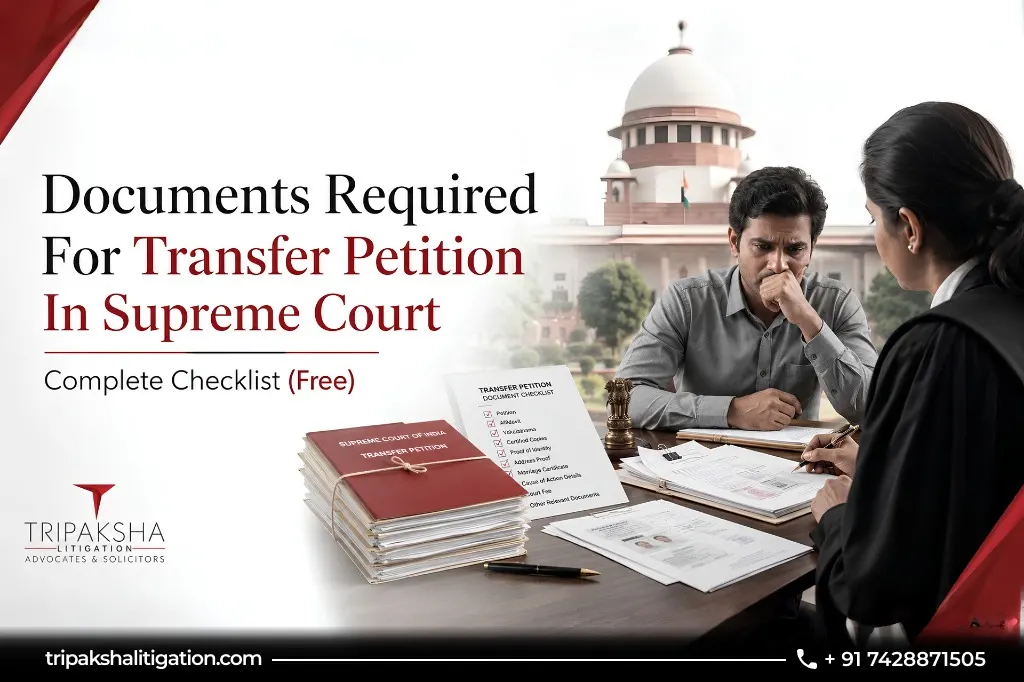
Before giving the brief to your Supreme Court Advocate-on-Record, keep one organised folder containing the pending petition, important orders, notices, complete case particulars, your proposed transferee court details, residence proof and every document supporting the grounds you intend to plead.
Then add only those medical, financial, child-related, safety or connected-case records that genuinely support your case.
Do not collect documents after drafting the story.
Collect the evidence first. Draft the story from the evidence.
That difference is often what separates a factual Transfer Petition from a collection of allegations.
CONCLUSION
A Transfer Petition in the Supreme Court succeeds on facts, supporting documents and properly established hardship—not on emotional allegations or lengthy pleadings.
For a civil or matrimonial inter-State transfer, the petition should be prepared under Section 25 CPC, in compliance with the Supreme Court Rules, 2013, with all relevant pleadings, orders, affidavits and supporting evidence properly placed on record.
The real test is simple: Can every important ground raised in your petition be supported by a credible document?
Whether the ground is distance, financial difficulty, medical condition, child-care responsibility, safety concerns or connected proceedings, documentary proof can significantly strengthen the case.
In transfer litigation, what you can prove before the Court will always carry more weight than what you merely allege.
FAQs
- What documents can make or break a Supreme Court transfer petition?
The petition, affidavit, case papers, key orders, annexures, Vakalatnama and documents proving your transfer grounds. - Can weak residence proof hurt your transfer petition?
Yes. If relocation or distance is your main ground, strong residence proof can become crucial. - Claiming medical hardship? What proof should you file?
Recent medical records, prescriptions and reports that actually show why travel is difficult. - Does filing a transfer petition stop the original case?
No. A separate request for stay/interim relief may be required. - Can a husband file a transfer petition in the Supreme Court?
Yes. Section 25 CPC applies to either party, and the Supreme Court examines comparative hardship and the ends of justice.