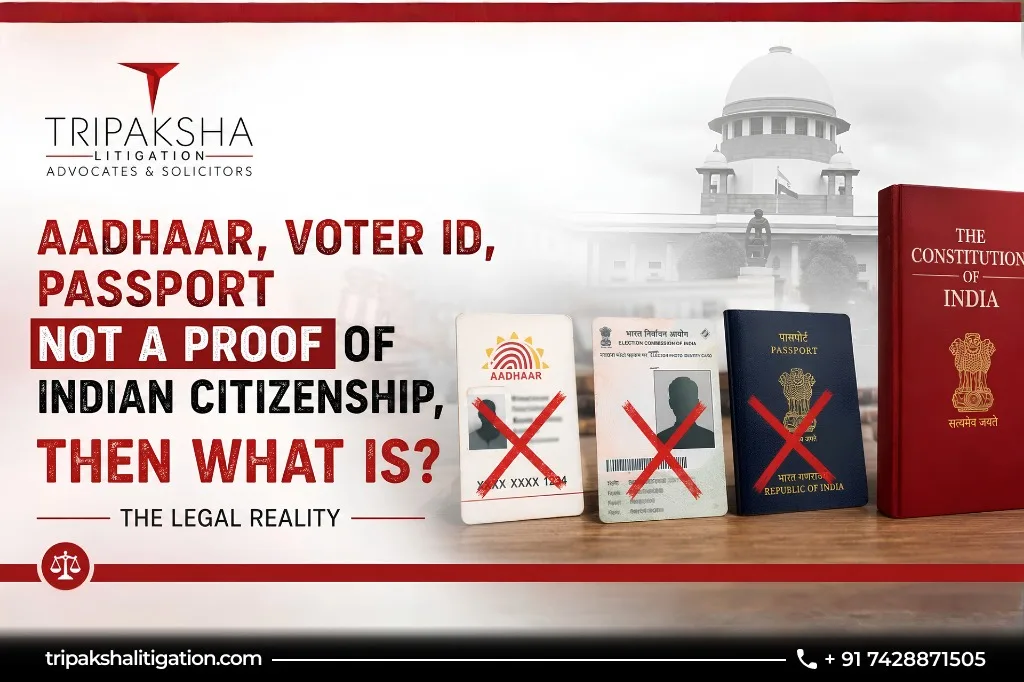
Aadhaar identifies you, Voter ID enrols you, Passport allows you to travel, but citizenship is a legal status decided by law, not by one document.
NEW DELHI: A passport can take an Indian citizen across international borders. It can help secure consular protection abroad. It is one of the strongest documents issued by the Indian State after verification.
Yet, the recent statement that a passport is not proof of citizenship has triggered a serious question:
If Aadhaar is not proof of citizenship, voter ID is not proof of citizenship, and a passport is also not conclusive proof of citizenship, then what exactly proves that a person is an Indian citizen?
The answer is uncomfortable but legally clear.
India does not have one universal citizenship card issued to every citizen. Citizenship is not proved by one common identity document. It is determined under the Constitution of India, the Citizenship Act, 1955, and the rules framed under it.
That is the legal reality.
Passport Looks Like Citizenship Proof, But Law Treats It Differently
For an ordinary citizen, the MEA statement may look strange.
After all, a passport is not issued casually. A person applies for it. Documents are checked. Police verification may be conducted. Government records are examined. The passport authority processes the application under the Passports Act, 1967.
Section 6(2)(a) of the Passports Act says that the passport authority shall refuse a passport if the applicant is not a citizen of India.
So naturally, the public asks:
If a passport is issued only after citizenship-related scrutiny, how can it not be proof of citizenship?
The legal answer is this:
A passport is strong evidence of citizenship, but it is not always conclusive proof of citizenship.
There is a difference between a document supporting a claim and a document finally deciding a legal status.
A passport shows that, at the time of issuance, the passport authority accepted the applicant’s claim for travel documentation. But if later facts show fraud, suppression, misrepresentation, wrong identity, foreign citizenship, illegal migration or some other statutory issue, the passport can be questioned, impounded or revoked.
That is why the passport is powerful evidence, but not the final legal certificate of citizenship.
Citizenship Is A Legal Status, Not Just A Document
The most important point is this:
Citizenship is not created by Aadhaar.
Citizenship is not created by PAN.
Citizenship is not created by voter ID.
Citizenship is not created by ration card.
Citizenship is not created merely by holding a passport.
Citizenship flows from law.
In India, citizenship comes through:
- Birth
- Descent
- Registration
- Naturalisation
- Incorporation of territory
These routes are provided under the Citizenship Act, 1955.
That means every citizenship claim must be tested according to the route through which citizenship is claimed.
For one person, the main proof may be birth in India and parents’ citizenship.
For another, it may be descent from Indian parents.
For another, it may be registration.
For another, it may be naturalisation.
For another, it may be a citizenship certificate issued by the Central Government.
This is why there is no single answer for every person.
Why Aadhaar Is Not Proof Of Citizenship
Aadhaar is one of the most commonly used identity documents in India. But legally, Aadhaar is not proof of citizenship.
Section 9 of the Aadhaar Act, 2016 makes this clear. Aadhaar number or Aadhaar authentication does not, by itself, prove citizenship or domicile.
This is because Aadhaar is based on residence and identity. It can be issued to residents, not only citizens.
So Aadhaar may prove that a person’s identity has been recorded in the Aadhaar system. It may help establish identity for welfare schemes, bank accounts, mobile connections or services. But it does not prove that the person is an Indian citizen.
Aadhaar answers the question: “Who is this person?”
It does not conclusively answer: “Is this person an Indian citizen?”
Why Voter ID Is Not Final Proof Of Citizenship
A voter ID card also creates confusion.
Under Indian law, only citizens can be enrolled as voters. So if a person has a voter ID, it means the electoral authorities treated that person as eligible for enrolment.
But voter ID is still not final proof of citizenship.
It proves that the person was enrolled in the electoral roll. It does not prevent later inquiry if the person’s eligibility, age, residence or citizenship is questioned.
The Representation of the People Act, 1950 allows correction, deletion and revision of electoral rolls. Electoral registration is an administrative act. It is important, but it is not the same as a citizenship certificate.
A voter ID supports a citizenship claim.
It does not finally settle citizenship if the issue is formally disputed.
Why Passport Is Also Not Conclusive Proof
A passport is stronger than Aadhaar or PAN because it is issued for international travel and is linked with nationality representation outside India.
But even passport is not treated as an unchallengeable citizenship certificate.
The Passports Act, 1967 allows the passport authority to inquire into the application. It also allows refusal if the applicant is not an Indian citizen. But the Act also gives power to impound or revoke a passport in certain situations.
That means the law itself recognises that issuance of passport is not the end of all future legal scrutiny.
A passport may show that the State accepted the claim at one point of time. But if the claim itself was wrong, fraudulent or legally defective, the passport cannot override the Citizenship Act.
The correct legal position is:
Passport is strong evidence of Indian citizenship, but not conclusive proof in every legal proceeding.
What About Birth Certificate?
A birth certificate is important, but even that is not always a complete answer.
This is because citizenship by birth in India has changed over time.
Broadly:
A person born in India before 1 July 1987 had a wider route to citizenship by birth.
A person born between 1 July 1987 and 3 December 2004 generally needed at least one Indian citizen parent.
A person born after 3 December 2004 generally needs both parents to be Indian citizens, or one parent to be an Indian citizen and the other not an illegal migrant.
Therefore, birth in India and citizenship of India are not always the same thing.
A birth certificate proves birth.
It may prove place of birth.
It may prove date of birth.
It may help prove parentage.
But depending on the year of birth and parents’ citizenship status, additional documents may still become relevant.
What Is The Best Proof Of Indian Citizenship?
The closest statutory answer is a citizenship certificate issued under the Citizenship Act.
Section 13 of the Citizenship Act, 1955 allows the Central Government, in cases where doubt exists, to certify that a person is a citizen of India. Such certificate is strong statutory proof unless it is shown that it was obtained by fraud, false representation or concealment of material facts.
But here is the real problem:
Such citizenship certificates are not issued automatically to every Indian citizen.
Most Indians are citizens by birth. They do not receive a separate citizenship certificate at birth. They live their entire lives with identity documents, school records, family records, birth records, voter records, passports, PAN, Aadhaar and residence documents.
So in practice, citizenship is proved through a chain of documents.
Citizenship Is Proved By A Combination Of Documents
In India, the practical proof of citizenship often depends on a “mosaic” of documents.
This may include:
- Birth certificate
- Parents’ birth certificates
- Parents’ citizenship-related records
- School certificates
- Passport
- Voter ID
- Electoral roll entries
- Residence records
- Land or property records
- Government service records
- Migration-related documents, where applicable
- Citizenship certificate, where applicable
- Registration or naturalisation certificate, where applicable
- Court or tribunal findings, where applicable
The stronger the chain, the stronger the citizenship claim.
One document may prove identity.
Another may prove birth.
Another may prove parentage.
Another may prove residence.
Another may prove State recognition.
Together, they may establish citizenship.
Important Laws On Proof Of Citizenship In India
| Law | Provision | Legal Relevance |
| Constitution of India | Articles 5 to 11 | Constitutional foundation of Indian citizenship |
| Citizenship Act, 1955 | Section 3 | Citizenship by birth |
| Citizenship Act, 1955 | Section 4 | Citizenship by descent |
| Citizenship Act, 1955 | Section 5 | Citizenship by registration |
| Citizenship Act, 1955 | Section 6 | Citizenship by naturalisation |
| Citizenship Act, 1955 | Section 7 | Citizenship by incorporation of territory |
| Citizenship Act, 1955 | Section 9 | Termination of citizenship on voluntary acquisition of foreign citizenship |
| Citizenship Act, 1955 | Section 10 | Deprivation of citizenship |
| Citizenship Act, 1955 | Section 13 | Certificate of citizenship in case of doubt |
| Citizenship Act, 1955 | Section 14A | National Register of Indian Citizens and national identity card framework |
| Passports Act, 1967 | Section 5 | Passport authority may conduct inquiry before issuing passport |
| Passports Act, 1967 | Section 6(2)(a) | Passport can be refused if applicant is not citizen of India |
| Passports Act, 1967 | Section 10 | Passport may be impounded or revoked |
| Aadhaar Act, 2016 | Section 9 | Aadhaar is not proof of citizenship or domicile |
| Representation of the People Act, 1950 | Sections 16, 22, 23 | Electoral roll eligibility, correction and deletion |
| Foreigners Act, 1946 | Section 9 | Burden of proof when question arises whether person is foreigner |
The Legal Problem With A Patchwork System
India has historically worked on a presumption that most people are citizens unless a dispute arises. That model worked for decades because ordinary citizens were rarely asked to prove citizenship formally.
But citizenship verification exercises, electoral roll revisions, migration-related proceedings and identity-linked governance have exposed a major gap.
The State has issued multiple documents to citizens and residents, but none of those documents has been made a universal citizenship document for every Indian.
This creates a strange situation.
A man may have Aadhaar.
He may have PAN.
He may have voter ID.
He may have passport.
He may have school records.
He may have birth certificate.
And yet, if citizenship is formally questioned, he may still be asked to prove the legal route through which he became an Indian citizen.
CONCLUSION
Aadhaar is not proof of citizenship.
Voter ID is not conclusive proof of citizenship.
Passport is strong evidence, but not final proof in every case.
PAN and ration card do not prove citizenship.
Birth certificate may help, but may not always be enough by itself.
The real proof of Indian citizenship depends on the Citizenship Act, 1955 and the route through which citizenship is claimed.
For some, it will be birth plus parents’ records.
For some, descent.
For some, registration.
For some, naturalisation.
For some, a citizenship certificate.
For others, a complete chain of documents showing birth, parentage, residence and State recognition.
The bigger question is not whether MEA is technically correct.
The bigger question is this:
In a modern democracy, should the most fundamental legal relationship between citizen and State depend on a confusing patchwork of documents?
Until India creates one clear and universally recognised citizenship document, this confusion will continue.
FAQs
- Is Aadhaar proof of Indian citizenship?
No. Aadhaar is proof of identity and residence-related enrolment. It is not proof of citizenship or domicile. - Is voter ID proof of citizenship?
No. Voter ID proves electoral enrolment. It supports a citizenship claim but does not conclusively prove citizenship if the matter is legally disputed. - Is passport proof of Indian citizenship?
Passport is strong evidence of citizenship, but it is not treated as conclusive proof in every legal proceeding. - What is the strongest proof of Indian citizenship?
A citizenship certificate issued under the Citizenship Act is the closest statutory proof, but it is not issued automatically to every citizen. - Can birth certificate prove citizenship?
It can help, but it may not be enough in every case because citizenship by birth depends on date of birth and parents’ citizenship status.