Article Summary
When cargo is damaged, lost, contaminated, short-delivered, or mishandled during transportation, the affected business may have claims against the carrier, transporter, shipping line, warehouse operator, or insurer, depending on the cause of loss and contractual arrangements. Immediate steps such as documenting the damage, obtaining a survey, preserving packaging, issuing timely notices, and collecting invoices, transport documents, photographs, and insurance records can be crucial. The appropriate legal remedy ultimately depends on the contract terms, insurance coverage, liability rules, and evidence of loss.
Legal Framework Governing Cargo Damage Claims in India
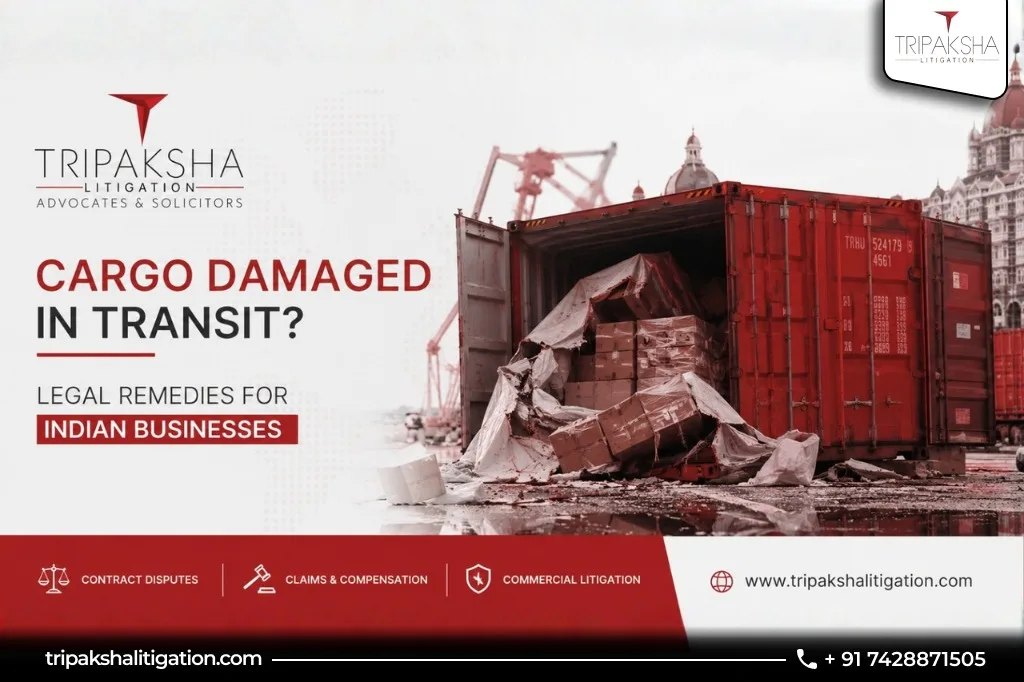
NEW DELHI: CARGO DAMAGED Every day, thousands of businesses across India entrust their goods to transporters, shipping lines, airlines, and logistics providers. Most shipments reach their destination safely. But when cargo arrives damaged, partially delivered, or does not arrive at all, the financial consequences can be severe. Businesses not only suffer direct losses but may also face cancelled orders, strained customer relationships, and disruption of supply chains.
The good news is that Indian law provides multiple remedies to businesses affected by cargo damage. Depending on whether the goods were transported by road, sea, or air, businesses can seek compensation from carriers, insurers, or other responsible parties. However, success often depends on acting promptly, preserving evidence, and understanding the legal framework governing cargo claims.
Understanding Cargo Damage in Transit
Cargo damage refers to any loss, deterioration, destruction, or shortage of goods while they are in transit.
Common forms of cargo damage include:
- Physical damage due to mishandling;
- Water, fire, or weather-related damage;
- Theft or pilferage;
- Short delivery of goods;
- Complete non-delivery;
- Damage caused by improper storage;
- Deterioration resulting from unreasonable delay.
Even minor damage can result in substantial commercial losses, particularly where the goods are perishable, fragile, or intended for time-sensitive contracts.
Who Is Legally Responsible?
Determining liability is often the first challenge.
Depending on the circumstances, responsibility may lie with:
The Carrier or Transporter: The road transporter, shipping line, airline, or logistics company entrusted with the cargo.
The Insurance Company: Where cargo insurance exists, the insurer may indemnify the business for covered losses.
The Warehouse Operator: If the goods were damaged while stored before or after transportation.
The Seller or Supplier: Where the contractual terms place delivery risk on the supplier.
The Consignor or Consignee: Where improper packaging, inaccurate declarations, or mishandling contributed to the loss.
The answer usually depends on the transport documents, contractual terms, and the applicable law.
Laws Governing Cargo Damage Claims in India
Carriers Act, 1865
The Carriers Act continues to play a crucial role in claims involving common carriers transporting goods by road.
The Act imposes a stringent standard of liability on common carriers. Once a claimant establishes that the goods were entrusted to the carrier and were subsequently lost or damaged, the burden shifts to the carrier to explain the circumstances.
This legal principle substantially protects businesses against negligent transporters.
Carriage by Road Act, 2007
The Carriage by Road Act regulates goods carriage by road and establishes obligations for transport operators.
The Act provides for:
- Registration of common carriers;
- Issuance of consignment notes;
- Rights and responsibilities of carriers;
- Documentation standards;
- Regulatory oversight.
Businesses should ensure that every shipment is accompanied by proper transport documentation, as these documents often become vital evidence during disputes.
Carriage by Air Act, 1972
Where goods are transported by air, the Carriage by Air Act governs the rights and liabilities of parties.
The Act incorporates international conventions dealing with air transport and addresses:
- Carrier liability;
- Compensation mechanisms;
- Notice requirements;
- Limitation periods;
- Domestic and international shipments.
Air cargo claims generally involve strict timelines, making prompt action essential.
Carriage of Goods by Sea Act, 2025
India’s maritime cargo regime underwent a significant reform with the enactment of the Carriage of Goods by Sea Act, 2025, replacing the colonial-era legislation that had governed sea cargo for nearly a century. The new law came into force on 10 September 2025.
The Act governs the rights, liabilities, responsibilities, and immunities of carriers transporting goods by sea from Indian ports.
It addresses issues relating to:
- Bills of lading;
- Carrier obligations;
- Cargo handling responsibilities;
- Liability for cargo loss and damage;
- Rights of shippers and consignees;
- International shipping standards.
The reform aims to simplify maritime trade law and improve ease of doing business in India’s shipping sector.
Marine Insurance Act, 1963
Cargo insurance often provides the quickest route to financial recovery.
The Marine Insurance Act governs:
- Cargo insurance contracts;
- Rights of insured businesses;
- Indemnity principles;
- Insurer obligations;
- Subrogation rights.
Once an insurer compensates the insured, it may pursue recovery proceedings against the responsible carrier.
Indian Contract Act, 1872
Many cargo disputes ultimately involve breach of contractual obligations.
Businesses may rely on contractual remedies where parties have agreed upon:
- Risk allocation;
- Delivery obligations;
- Compensation clauses;
- Limitation provisions;
- Dispute resolution mechanisms.
The Act permits recovery of damages arising from contractual breaches.
Consumer Protection Act, 2019
Businesses qualifying as consumers under the Act may invoke consumer jurisdiction where there is deficiency in transportation services.
Consumer forums often provide comparatively faster and less expensive remedies in suitable cases.
Immediate Steps After Discovering Cargo Damage
The actions taken immediately after discovering damage can significantly impact the outcome of future claims.
Step 1: Document the Damage
Take clear photographs and videos showing:
- The condition of the goods;
- Packaging defects;
- External damage;
- Delivery vehicle condition.
Step 2: Notify the Carrier
Issue written notice immediately to the transporter or logistics provider.
Avoid relying solely on oral communication.
Step 3: Obtain a Survey Report
Where the loss is substantial, engage an independent surveyor to assess the extent and probable cause of damage.
Step 4: Preserve Evidence
Do not discard:
- Damaged packaging;
- Labels;
- Seals;
- Pallets;
- Delivery documents.
These items may become crucial evidence.
Step 5: Inform the Insurer
Most insurance policies require prompt notification.
Delays can jeopardise the claim.
Step 6: Gather Documentation
Maintain copies of:
- Tax invoices;
- Consignment notes;
- Bills of lading;
- Air waybills;
- E-way bills;
- Delivery receipts;
- Insurance policies;
- Correspondence exchanged.
Filing a Compensation Claim
Businesses generally have multiple avenues available.
Internal Claim Procedure: Most carriers have dedicated claims processes requiring submission of supporting documents.
Insurance Claim: If insured, lodge the claim immediately in accordance with policy conditions.
Legal Notice: A formal legal notice often precedes litigation and may encourage settlement.
Arbitration: Where contracts contain arbitration clauses, disputes may require resolution through arbitral proceedings.
Civil Proceedings: Businesses can institute civil suits seeking compensation.
Consumer Proceedings: Eligible claimants may approach consumer forums alleging deficiency in service.
Landmark Indian Case Laws
Nath Bros. Exim International Ltd. v. Best Roadways Ltd. (2000) 4 SCC 553
The Supreme Court held that once loss or damage to goods entrusted to a common carrier is established, negligence need not be independently proved by the claimant.
Transporters cannot avoid liability merely by forcing businesses to establish precisely how the damage occurred.
This decision remains one of the strongest precedents protecting cargo owners.
Patel Roadways Ltd. v. Birla Yamaha Ltd. (2000) 4 SCC 91
The Supreme Court clarified that the burden rests upon the carrier to prove absence of negligence.
The law recognises the practical difficulty faced by cargo owners in establishing what transpired during transit.
Economic Transport Organization v. Charan Spinning Mills (P) Ltd. (2010) 4 SCC 114
The Court examined the rights of insurers after settlement and clarified the doctrine of subrogation.
Businesses may recover from insurers without losing the insurer’s ability to pursue the responsible carrier.
River Steam Navigation Co. Ltd. v. Shyam Sunder Tea Co. Ltd. AIR 1962 SC 1276
The Supreme Court examined contractual limitations and obligations of carriers.
Transport contracts should never be treated as routine paperwork. Liability clauses can substantially affect recovery rights.
Important Limitation Periods Businesses Must Know
| Type of Claim | Relevant Law | Practical Considerations |
| Road Transport | Carriers Act / Limitation Act | Timely notice and prompt legal action advisable |
| Air Cargo | Carriage by Air Act | Strict limitation timelines apply |
| Sea Cargo | Carriage of Goods by Sea Act and contractual terms | Bills of lading may prescribe notice requirements |
| Insurance Claims | Policy Conditions | Immediate intimation is essential |
| Civil Recovery | Limitation Act, 1963 | Generally three years from accrual of cause of action |
Businesses should seek legal advice early rather than waiting until limitation periods approach expiry.
Practical Tips to Minimise Future Cargo Disputes
- Purchase adequate cargo insurance.
- Conduct pre-dispatch inspections.
- Verify transporter credentials.
- Use robust packaging standards.
- Preserve dispatch records.
- Review liability clauses before signing contracts.
- Include arbitration provisions where appropriate.
- Train logistics personnel regarding documentation and claims procedures.
- Maintain digital records of every shipment.
- Establish internal escalation mechanisms for damaged consignments.
CONCLUSION
Cargo damage is more than a logistical inconvenience. For businesses, it can mean disrupted operations, damaged customer relationships, and significant financial losses. Fortunately, Indian law offers a comprehensive framework to protect commercial interests through statutory remedies, insurance mechanisms, and judicial precedents.
The key lies in acting swiftly. Businesses that document losses carefully, preserve evidence, comply with notice requirements, and understand their legal rights stand a far greater chance of recovering their losses.
In today’s increasingly complex supply chains, insurance is important, but legal preparedness is indispensable. A well-informed business is not merely better equipped to respond to cargo damage; it is better positioned to prevent disputes, negotiate from strength, and safeguard its commercial interests.
FAQs
- Can compensation be claimed from the transporter without cargo insurance?
Yes. The absence of cargo insurance does not prevent recovery proceedings against the carrier responsible for the loss or damage. - How quickly should cargo damage be reported?
Cargo damage should be reported immediately after discovery, as delays in notifying the carrier or insurer may adversely affect the claim. - What documents are required to support a cargo damage claim?
Invoices, consignment notes, bills of lading or air waybills, delivery receipts, photographs of the damage, and insurance documents are generally required. - Can compensation be recovered from both the insurer and the transporter?
An insurer may first indemnify the loss, following which it can pursue the responsible carrier through subrogation rights. - What is the time limit for initiating a cargo damage claim?
The limitation period varies depending on the applicable law and mode of transport, making prompt legal action essential.