Article Summary
Police in India can seize a mobile phone during an investigation when there is a lawful investigative basis, but seizure, searching the phone’s contents, demanding passwords, and retaining the device are separate legal issues. The BNSS provides procedural safeguards for search and seizure, while Articles 20(3) and 21 protect against self-incrimination and safeguard privacy. If relevant digital evidence has already been preserved, courts may also permit the return of the physical device subject to appropriate conditions.
Complete Legal Guide 2026: When Police Can Seize Your Phone, Search Its Data, Ask for Passwords and How to Get It Back
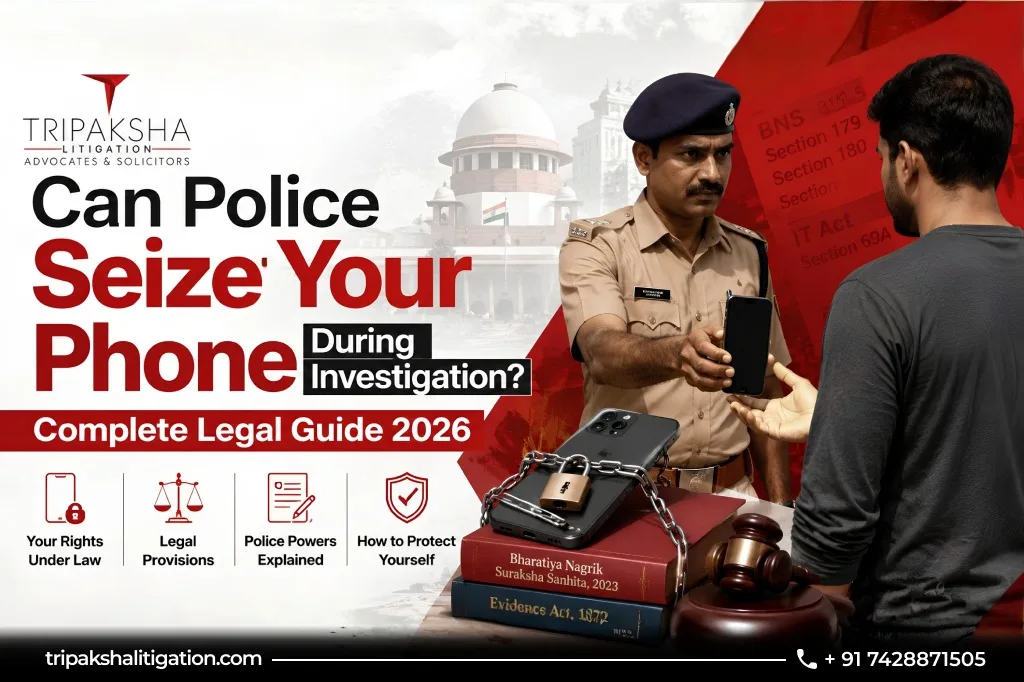
NEW DELHI: A mobile phone is no longer just a device for calls. It can contain WhatsApp chats, photographs, banking records, emails, location history, work files and years of personal data. That is why when police seize or demand access to a phone during an investigation, the legal issue goes far beyond simply taking possession of the handset.
Under Indian law in 2026, four different questions must be examined separately: Can police seize your phone? Can they search its contents? Can they compel you to unlock it or disclose your password? And how long can they legally keep the device?
The answer is not a blanket yes or no.
Police can lawfully seize a mobile phone where there is a valid investigative basis, and the requirements of the BNSS are satisfied. But seizing the handset, accessing its digital contents, compelling password disclosure and retaining the phone for an extended period are legally distinct issues.
A mobile phone may be treated as property, and its contents may constitute digital evidence, but access to that data can also involve Article 20(3) protection against self-incrimination and the constitutional right to privacy under Article 21.
This guide explains exactly where police powers begin, where legal safeguards apply and what you can do if your phone is seized during an investigation.
WHICH BNSS PROVISIONS APPLY TO A MOBILE PHONE?
Section 94 BNSS expressly covers “electronic communication” and “communication devices” likely to contain digital evidence. A Court may issue a summons, and the officer in charge of a police station may issue a written order, requiring production of a document, device or other thing considered necessary or desirable for an investigation, inquiry or proceeding.
But an important limitation arises when the person is an accused and the demand is for material likely to incriminate him.
In State of Gujarat v. Shyamlal Mohanlal Choksi, AIR 1965 SC 1251, a Constitution Bench of the Supreme Court, while interpreting the predecessor production provision, held that it should not be read as compelling an accused to produce incriminating material against himself.
The BNSS applied that principle directly in 2026.
On 13 July 2026, the Telangana High Court in Kutikanti Sridhar v. State of Telangana set aside a Section 94 BNSS notice issued to an accused.
On the same day, in Konda Venkata Narsimha Reddy v. State of Telangana, the Telangana High Court held that an accused cannot be required under Section 94 BNSS to produce evidence likely to incriminate himself.
This is an important 2026 development for anyone receiving a police notice demanding a phone or digital material.
CAN POLICE SEIZE YOUR PHONE WITHOUT A WARRANT?
Yes, in legally recognised circumstances.
India has no universal rule requiring police to obtain a judicial warrant before every mobile phone seizure.
Section 106 BNSS permits a police officer to seize property alleged or suspected to have been stolen, or property found in circumstances creating suspicion of the commission of an offence. The police must report the seizure forthwith to the jurisdictional Magistrate.
That power does not permit seizing every phone merely because its owner is under suspicion. A legally sustainable connection must exist between the property and the investigation.
Police also have warrantless search powers under Section 185 BNSS.
The investigating officer must have reasonable grounds to believe that something necessary for the investigation may be found at a place and cannot otherwise be obtained without undue delay. The grounds must be recorded in writing, the thing sought should be specified as far as possible, and the prescribed records must reach the competent Magistrate forthwith and not later than 48 hours.
In Khushbu v. State of Maharashtra, decided on 3 July 2026, the Bombay High Court stressed that the power under Section 185 BNSS is not unfettered and that its procedural safeguards require strict compliance.
SEARCH AND SEIZURE MUST BE AUDIO-VIDEO RECORDED
This is one of the most important safeguards under the new criminal procedure law.
Section 105 BNSS requires the process of conducting a search or taking possession of property under the relevant provisions, including preparing the seizure list and having it signed by witnesses, to be recorded through audio-video electronic means, preferably a mobile phone. The recording must be forwarded without delay to the specified Magistrate.
In Gokal Ram v. State of Rajasthan, decided on 30 April 2026, the Rajasthan High Court treated the word “shall” in Section 105 as obligatory and described electronic recording as an important safeguard for transparency, accountability and fairness.
If your phone is taken during a search, procedure is not a technical formality. It forms part of the legality and transparency of the evidence-collection process.
SEIZING A PHONE IS NOT THE SAME AS SEARCHING YOUR DIGITAL LIFE
A smartphone may reveal relationships, finances, photographs, work material, location history and years of private communication.
In Justice K.S. Puttaswamy (Retd.) v. Union of India, (2017) 10 SCC 1, a nine-judge Bench of the Supreme Court recognised privacy as a fundamental right protected by the Constitution.
Puttaswamy does not mean that every phone search automatically requires a warrant.
It establishes that State intrusion into privacy must have a legal basis and satisfy constitutional requirements, including a legitimate purpose and proportionality.
A lawful investigation can justify access to relevant digital evidence. It does not automatically make every unrelated photograph, private conversation, account or document stored on the phone relevant to that investigation.
CAN POLICE FORCE YOU TO GIVE YOUR PHONE PASSWORD?
This is where much of the advice circulating online becomes dangerously absolute.
Indian High Courts have taken differing approaches.
Article 20(3) of the Constitution of India protects an accused from being compelled to testify against himself.
In State of Bombay v. Kathi Kalu Oghad, AIR 1961 SC 1808, the Supreme Court distinguished testimonial material based upon personal knowledge from physical or mechanical evidence such as fingerprints and specimen handwriting.
How that principle applies to phone passwords has produced different judicial approaches.
In Virendra Khanna v. State of Karnataka, 2021 SCC OnLine Kar 5032, the Karnataka High Court took the view that providing a password, passcode or biometrics would not by itself amount to testimonial compulsion.
However, the Court also set aside the trial-court direction requiring disclosure because examining the smartphone constituted a search, and a proper lawful search procedure had to be followed.
The Delhi High Court took a more protective approach in Sanket Bhadresh Modi v. CBI, Bail Appln. 3754/2023, decided on 18 December 2023.
When the CBI complained that passwords had not been shared, the Court said an investigating agency cannot expect an accused to “sing in a tune which is music to their ears” and held, on the facts of that bail proceeding, that the applicant could not be coerced to disclose passwords in view of Article 20(3).
Therefore, do not reduce Indian law to either:
“Police can always force you to reveal your password.”
or
“Police can never ask for your password.”
Both are too broad.
As of my research cut-off of 27 August 2026, I did not find a final Supreme Court judgment laying down one comprehensive nationwide rule specifically governing compelled disclosure of smartphone passcodes. The proceedings in Foundation for Media Professionals v. Union of India, which address broader safeguards for searching and seizing digital devices, remain listed as pending.
HOW LONG CAN POLICE KEEP YOUR PHONE?
No universal rule requires police to keep every seized mobile phone until the criminal trial ends.
In Sunderbhai Ambalal Desai v. State of Gujarat, (2002) 10 SCC 283, the Supreme Court emphasised prompt judicial handling of seized property, rather than allowing it to remain unnecessarily in custody for years.
Under the BNSS, Section 497 empowers the Court or Magistrate to pass appropriate orders on the custody of property during investigation, inquiry, or trial.
Section 503 BNSS deals with property seized by police and reported to a Magistrate where the property is not produced before a criminal court during inquiry or trial.
For the return of a seized mobile phone, the practical question is often whether relevant data can first be forensically extracted and preserved while the physical handset is returned subject to appropriate conditions.
2026 HIGH COURTS: PRESERVE THE EVIDENCE, RETURN THE DEVICE WHEN POSSIBLE
Recent 2026 decisions clearly demonstrate this approach.
In Karthikraja S. v. State, the Madras High Court dealt with laptops and mobile phones seized in April 2025. After repeated delays in obtaining the forensic report, the Court had directed their “forthwith return” in February 2026.
On 24 June 2026, after the forensic report disclosed nothing against the petitioners, the High Court directed release of the devices within two weeks subject to conditions.
In Nasleena K.C. v. Central Bureau of Investigation, decided on 24 February 2026, the Kerala High Court noted that the Forensic Science Laboratory had already copied all data from the seized mobile phone and laptop and produced it before the jurisdictional court.
The Court found no legal impediment to granting interim custody, subject to safeguards.
In Akshay v. State of Rajasthan, 2026:RJ-JP:32202, decided on 7 July 2026, the Rajasthan High Court noted that relevant online transaction data had already been collected and the investigation was over.
It ordered the release of an iPhone that had remained in custody since 2023, subject to conditions including preserving identifying particulars and producing the device whenever required.
The practical principle emerging from these cases is significant:
Preserving digital evidence does not always require keeping the owner’s physical handset indefinitely.
DIGITAL EVIDENCE MUST BE PRESERVED, NOT DESTROYED
The Bharatiya Sakshya Adhiniyam, 2023 gives statutory recognition to electronic and digital records and provides the current evidentiary framework governing them.
Forensic extraction, device identification, and preservation of the original data trail can matter to both the prosecution and the defence.
A selectively produced screenshot can tell a very different story from the complete conversation.
This becomes particularly important in matrimonial, financial, workplace and relationship-linked criminal cases.
If an allegation is false, exaggerated or stripped of context, full WhatsApp conversations, call records, payment trails, photographs or contemporaneous messages may contain the very material needed to establish what actually happened.
Deleting everything out of panic can therefore become one of the worst mistakes an accused person makes.
Do not wipe chats, remotely erase a device, reset accounts or manufacture a “clean” record after a criminal dispute begins. You may destroy evidence useful to your own defence and invite an allegation of tampering.
WHAT SHOULD YOU DO IF POLICE SEIZE YOUR PHONE?
- Do not physically resist a lawful seizure.
- Ask for the officer’s name, police station, FIR or complaint details and legal basis for taking the device.
- Ask for the seizure memo or applicable search record. Check whether the make, model, IMEI, SIM and accessories have been correctly recorded.
- Where Section 105 BNSS applies, note whether the search and seizure process is being audio-video recorded.
- Do not wipe, reset, remotely erase or alter the phone or connected accounts.
- Do not casually sign sweeping consent for unrestricted access without first understanding what you are consenting to.
- If you are an accused and are asked to produce incriminating digital material or disclose a passcode, obtain case-specific legal advice before responding. Section 94 BNSS, Article 20(3) and the exact facts can materially change the legal position.
- If the relevant data has already been extracted and the phone is required for work, banking, OTPs or daily life, consider moving the jurisdictional Court or Magistrate for interim custody or return of the seized mobile phone.
CONCLUSION
Police can seize a mobile phone during an investigation, but that power is not unlimited. Taking the handset, searching its contents, demanding a password and retaining the device are separate legal issues, each governed by its own statutory and constitutional safeguards.
Under the BNSS, police must follow the prescribed search and seizure procedure. At the same time, Article 20(3) protects against compelled self-incrimination, while Article 21 protects privacy. Courts have also made it clear that once relevant digital evidence is preserved, continued retention of the physical device may not always be necessary.
The practical rule is simple: do not obstruct a lawful investigation, but do not surrender your legal rights blindly either. If your phone is seized, insist on proper documentation, preserve your own records, avoid deleting or altering data and seek appropriate legal remedy if the device is being retained without sufficient justification.
FAQs
- Can police seize your phone without arresting you?
Yes, if there is a lawful investigative basis and proper procedure is followed. - Can police take your phone without a warrant?
Yes, in certain cases under Sections 106 and 185 of the BNSS. - Can police force you to reveal your phone password?
Not automatically. Courts have taken different views, and Article 20(3) may apply. - Can you get your seized phone back before trial?
Yes. Courts may order its return once they have preserved relevant digital evidence. - Can police force an accused to produce incriminating digital evidence?
Not automatically under Section 94 BNSS, especially where self-incrimination is involved.