Article Summary
False allegations posted online can seriously harm a person’s reputation, career, business, and personal relationships. Indian law provides remedies when defamatory statements are published through social media, websites, online reviews, messages, or other digital platforms. Affected individuals may consider civil and criminal remedies, injunctions, damages, takedown requests, and legal notices depending on the circumstances. Preserving screenshots, URLs, dates, account details, and other digital evidence is important before taking legal action.
From False Social Media Posts to Defamation Complaints, Civil Damages, Injunctions and Takedown Orders: Know Your Legal Remedies in India
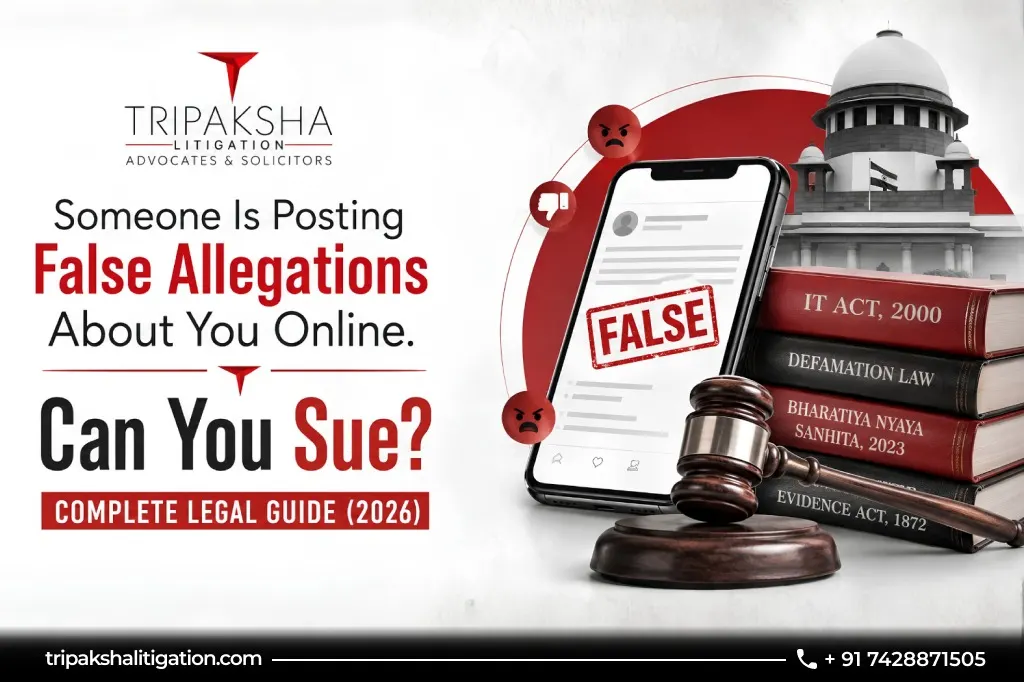
NEW DELHI: A false allegation posted on Instagram, X, Facebook, YouTube, WhatsApp, Reddit, a review platform or a website can damage a person’s reputation long before any court gets an opportunity to examine the truth.
A single post can reach employers, clients, relatives, colleagues and business associates within minutes. In matrimonial and relationship disputes, the reputational damage may begin even before an investigation is completed, a charge-sheet is filed or the accused person gets an opportunity to place his side on record.
However, every insult, criticism or negative review does not automatically amount to defamation. The legal question is whether a defamatory imputation was made or published concerning an identifiable person, whether it was capable of lowering that person’s reputation in the estimation of others and whether any recognised legal defence or exception applies.
In 2026, online defamation in India is primarily examined under Section 356 of the Bharatiya Nyaya Sanhita, 2023 (BNS), Section 222 of the Bharatiya Nagarik Suraksha Sanhita, 2023 (BNSS), the Bharatiya Sakshya Adhiniyam, 2023 (BSA), the Limitation Act, 1963, civil defamation principles and the Information Technology (Intermediary Guidelines and Digital Media Ethics Code) Rules, 2021, as amended.
If someone is publishing false allegations about you online, you may, depending on the facts, have the option of filing a civil defamation suit seeking damages or an injunction, seeking removal of the offending content, and/or initiating a criminal defamation complaint under Section 356 BNS.
But a defamation case should begin with evidence, not anger. The exact words, video, image or post must first be identified and preserved along with its complete context. You must then examine who published it, whether it clearly refers to you, what evidence proves the allegation false or defamatory, what legal defence may be raised and which remedy is most effective in your particular case.
WHAT COUNTS AS ONLINE DEFAMATION IN INDIA?
Section 356(1) BNS covers a person who, by spoken or written words, signs or visible representations, makes or publishes an imputation concerning a person while intending, knowing or having reason to believe that it will harm that person’s reputation.
That can cover digital publication. A post, video, caption, public group message, online review, blog article or edited image can potentially be defamatory if the statutory ingredients are satisfied.
Explanation 4 links reputational harm to lowering a person in the estimation of others, including his moral or intellectual character, character in respect of calling or credit. That is why publication matters. A private insult sent only to you may be actionable under some other law depending on its contents, but defamation ordinarily concerns an imputation communicated in a manner capable of lowering you in the estimation of others.
False accusations of rape, domestic violence, dowry harassment, cheating, fraud, theft or professional dishonesty can be extremely serious. But courts examine the actual words, context, audience, intent or knowledge and the statutory exceptions.
FALSE ALLEGATION OR PROTECTED SPEECH? THE DIFFERENCE IS CRITICAL
Not every statement that harms reputation will amount to criminal defamation. Section 356 BNS recognises ten statutory exceptions, and these exceptions often determine whether a complaint is legally sustainable.
Truth is relevant, but in criminal defamation it is not a complete defence on its own. The first exception protects a true imputation when its publication is also shown to be for the public good, and whether such public good exists is ultimately a question of fact.
The remaining exceptions protect, among other things, certain good-faith opinions, substantially true reports of judicial proceedings, accusations made in good faith to a person with lawful authority, statements made to protect a legitimate interest, and cautions given in good faith.
This distinction is particularly important in matrimonial and criminal disputes. A complaint made in good faith before the police, a court or another competent authority stands on a very different legal footing from publicly circulating an accusation before thousands of people and presenting the accused as guilty even before the allegation has been judicially tested.
In Shahed Kamal & Ors. v. M/s A. Surti Developers Pvt. Ltd. & Anr., 2025 INSC 502, the Supreme Court quashed criminal-defamation proceedings arising out of a homebuyer protest after examining the words used, the surrounding circumstances and the protection available to a good-faith assertion of legitimate interests.
The principle is clear: a statement does not become criminal defamation merely because it is critical, unpleasant or damaging to someone’s image. At the same time, freedom of speech cannot be used as a licence to make reckless or defamatory allegations, just as defamation law cannot be used to silence every form of legitimate criticism.
CAN YOU FILE A CRIMINAL CASE FOR ONLINE DEFAMATION?
Yes, where the ingredients of BNS Section 356 are made out.
Section 356(2) provides simple imprisonment up to two years, or fine, or both, or community service. Under the First Schedule to the BNSS, ordinary defamation is non-cognizable and bailable and is triable by a Magistrate of the First Class.
This is frequently misstated online. For pure criminal defamation, the normal route is not an automatic police FIR followed by arrest. Section 222 BNSS requires, subject to its special provisions, a complaint by a person aggrieved before a court can take cognisance of an offence under Section 356.
If the same conduct independently discloses another cognizable offence, such as threats, extortion, forgery, or another offence depending on the facts, the police position may differ because the case is no longer limited to defamation.
And Section 66A of the Information Technology Act is not a shortcut.
In Shreya Singhal v. Union of India, (2015) 5 SCC 1, the Supreme Court struck Section 66A down in its entirety. It cannot be revived simply because the statement was made online.
Anyone advising you in 2026 to simply “file 66A” for an offensive social-media post is relying on a provision that has been unconstitutional for more than a decade.
CAN YOU SUE FOR MONEY AND AN INJUNCTION?
Yes. Indian civil law also permits defamation claims seeking damages and, where justified, preventive or mandatory injunctive relief, including targeted restraint or removal of identified material.
But an injunction is not granted merely because the claimant says the post is false.
In Bloomberg Television Production Services India Pvt. Ltd. v. Zee Entertainment Enterprises Ltd., 2024 INSC 255, the Supreme Court held that the familiar three-part injunction test, prima facie case, balance of convenience and irreparable injury, applies in defamation cases and “must not be applied mechanically.”
The Court also stressed caution with ex parte pre-trial restraints on publication because reputation and privacy must be balanced against freedom of speech and public interest.
So an application to remove defamatory content online should identify the precise statements, URLs or unique locations, demonstrate why they are false or legally indefensible, show continuing harm and explain why damages alone are inadequate.
A vague request to erase every criticism is much weaker than a targeted challenge to specific demonstrably false allegations.
In Subramanian Swamy v. Union of India, (2016) 7 SCC 221, the Supreme Court upheld criminal defamation while recognising reputation as an important facet of Article 21 and balancing it against freedom of speech under Article 19(1)(a).
CAN YOU FORCE INSTAGRAM, X, FACEBOOK, YOUTUBE OR ANOTHER PLATFORM TO REMOVE IT?
Sometimes, but you need to read the 2026 intermediary rules precisely.
Under Rule 3 of the Information Technology (Intermediary Guidelines and Digital Media Ethics Code) Rules, 2021, an intermediary must maintain a grievance mechanism.
Under the rules updated in February 2026, a grievance is generally to be acknowledged within 24 hours and resolved within seven days. Certain specified removal requests have a 36-hour resolution period, while specified complaints involving private-area nudity, sexual material or electronic impersonation, including artificially morphed images, have a two-hour action requirement.
For unlawful content covered by Rule 3(1)(d), which expressly includes defamation, “actual knowledge” has a narrower statutory meaning.
It arises through an order of a court of competent jurisdiction or a qualifying reasoned written intimation from an appropriately authorised government or agency officer. Following the February 2026 amendment, the intermediary must remove or disable access to the identified unlawful information within three hours after receiving such qualifying actual knowledge.
That distinction matters.
A private defamation legal notice sent to Instagram, X, Facebook, YouTube, or another intermediary does not, by itself, magically become a court order or authorised government intimation under Rule 3(1)(d).
A legal notice can still be strategically useful. It can demand withdrawal from the author, invoke the platform grievance process, identify exact URLs and create a record of notice.
But it is legally incorrect to write in every notice that a platform must remove every allegedly defamatory post within three hours merely because your lawyer emailed it.
If voluntary removal fails and the publication is causing serious continuing harm, a properly framed court application for targeted injunctive relief may be the effective route.
WHAT EVIDENCE SHOULD YOU SAVE BEFORE THE POST DISAPPEARS?
Electronic evidence can vanish or lose context. Preserve it before confrontation.
Sections 61 to 63 BSA govern electronic and digital records, with Section 63 prescribing conditions for computer output and a certificate framework. The statutory Schedule also contemplates identifying the device or source and hash values.
Do not build the case around one cropped screenshot.
Preserve the full URL, username and profile URL, date and time, complete post or thread, comments, quoted posts or reposts, captions, thumbnails, audio and video, and surrounding context. Keep original files where available.
A continuous screen recording showing the account and navigation can supplement screenshots. Preserve messages relevant to authorship or motive and evidence of reputational consequences, such as a client or employer referring to the post.
When you rely on computer output in court, handle BSA Section 63 electronic evidence correctly.
Anonymous accounts create another problem. A display name is not proof of identity. Depending on the proceeding and available facts, you may need to seek preservation or disclosure directions against the relevant intermediary or service provider.
HOW LONG DO YOU HAVE TO FILE A CIVIL DEFAMATION SUIT?
Do not sit on the claim.
Article 75 of the Limitation Act, 1963 prescribes one year for a suit seeking compensation for libel, running from when the libel is published. Article 76 separately deals with compensation for slander.
In Darshan Singh v. Yudhishtir Singh, 2026:MPHC-GWL:11706, decided on 7 April 2026, the Madhya Pradesh High Court reiterated the publication-based limitation rule and discussed republication as potentially creating a fresh cause in appropriate circumstances.
That does not mean an old post automatically receives an endless fresh limitation period merely because it remains searchable. Publication, republication and limitation can be fact-sensitive. If civil damages matter, act early.
WHAT SHOULD YOU DO IN THE FIRST 48 HOURS?
- Preserve the evidence first. Save URLs, account details, complete context, screenshots, screen recordings and original media before reporting the post.
- Isolate the exact allegation. Do not merely say the entire post is “defamatory.” Identify the precise factual imputations.
- Collect evidence disproving it. Preserve court records, messages, financial records, correspondence or other lawful evidence directly relevant to the allegation.
- Use the correct takedown route. File a precise platform grievance with exact URLs and consider a targeted notice to the publisher where appropriate.
- Choose the remedy that matches the objective. That may mean correction or withdrawal, civil injunction and damages, criminal defamation, or action for a separate offence actually disclosed by the facts.
Do not retaliate with counter-allegations you cannot prove. Do not threaten criminal cases merely to force an apology.
In reputation litigation, discipline often matters more than volume.
ONLINE FALSE ALLEGATIONS IN MATRIMONIAL AND RELATIONSHIP DISPUTES
This is where the gap between an allegation and a judicial finding becomes dangerous.
A criminal allegation remains an allegation until tested according to law. Yet a social-media post can label a man a rapist, dowry harasser, abuser, fraudster or criminal before a court has examined a witness.
Employers react. Clients disappear. Families panic. Search results remain.
And acquittal, closure or quashing may come years after the first accusation travelled across the internet.
For men facing false or exaggerated allegations, one of the worst strategies is to conduct the entire case through Instagram stories, WhatsApp groups and public counter-accusations.
Preserve evidence. Build the chronology. Identify inconsistencies. Use the correct court or authority. If reputational relief is necessary, seek it with precise pleadings and precise URLs.
At the same time, defamation law should not be used to frighten a genuine complainant from approaching police, court or another lawful authority. Section 356 itself contains good-faith protections for certain accusations made to lawful authorities.
The law must protect genuine victims.
It must also protect innocent people from being publicly convicted by a social-media narrative before evidence is tested.
That is not a gender privilege. It is a rule-of-law requirement.
WHAT THE COURTS HAVE ACTUALLY SAID
| Case | Court’s position | Practical lesson |
| Subramanian Swamy v. Union of India, (2016) 7 SCC 221 | Supreme Court upheld criminal defamation and recognised constitutional protection for reputation. | Free speech and reputation must be balanced. |
| Shreya Singhal v. Union of India, (2015) 5 SCC 1 | The Supreme Court struck down Section 66A of the IT Act; it read down Section 79. | Do not use Section 66A as an online-speech shortcut. |
| Bloomberg Television Production Services India Pvt. Ltd. v. Zee Entertainment Enterprises Ltd., 2024 INSC 255 | Pre-trial defamation injunctions require rigorous and reasoned application of injunction principles. | A takedown request must be precise and proved. |
| Shahed Kamal & Ors. v. M/s A. Surti Developers Pvt. Ltd. & Anr., 2025 INSC 502 | Criminal defamation proceedings arising from a good-faith consumer protest were quashed on the facts. | Not every damaging criticism is criminal defamation. |
| Darshan Singh v. Yudhishtir Singh, 2026:MPHC-GWL:11706 | Article 75 limitation for libel compensation runs from publication. | Delay can defeat a civil damages claim. |
Courtroom remarks are often reported selectively, and a reported judgment may not reproduce every oral exchange that took place during the hearing. For that reason, legal analysis should rely on the findings and observations actually recorded in the judgment rather than reconstructing or dramatising courtroom dialogue.
In Bloomberg Television Production Services India Pvt. Ltd. v. Zee Entertainment Enterprises Ltd., the Supreme Court cautioned that the principles governing injunctions in defamation cases “must not be applied mechanically.”
Similarly, in Shreya Singhal v. Union of India, the Supreme Court held that Section 66A of the Information Technology Act was “struck down in its entirety.”
These recorded judicial observations carry far greater legal value than sensationalised or reconstructed courtroom exchanges. For any serious legal article, the judgment itself should remain the primary source.
CONCLUSION
False allegations online can damage a reputation within minutes, but a successful defamation case depends on evidence, not outrage.
The first priority should be to preserve the exact post, video, message, URL and surrounding context. The next step is to determine whether the statement is actually defamatory, whether it can be proved false or legally indefensible, what defence may be available to the publisher and which remedy best addresses the continuing harm.
Depending on the facts, that remedy may include a criminal defamation complaint under Section 356 BNS, a civil suit for damages, an injunction or takedown order, or proceedings arising from other offences independently disclosed by the conduct.
For men facing public accusations during matrimonial or relationship disputes, the temptation to fight the case on social media can be particularly damaging. A counter-allegation, angry response or poorly worded threat may eventually become evidence against you.
Preserve the record. Build the chronology. Identify the precise false allegation. Then use the legal remedy that fits the facts.
Social media may pronounce guilt in seconds. A court requires proof.
And ultimately, it is the judicial finding—not the loudest online accusation—that determines what the law accepts as fact.
FAQs
- Can I sue someone for false allegations on social media in India?
Yes. You may seek civil damages, an injunction or file a criminal defamation complaint under Section 356 BNS, depending on the facts. - Can police register an FIR only for defamation under Section 356 BNS?
Ordinary defamation is non-cognizable and bailable. The usual route is a complaint under Section 222 BNSS. - Can I force Instagram or X to remove a defamatory post?
You can use the platform grievance process or seek court relief. A qualifying court or government direction can trigger removal obligations under the IT Rules. - Is a screenshot enough to prove online defamation?
Not always. Preserve the URL, full context, account details, original media and Section 63 BSA-compliant electronic evidence. - How long do I have to sue for online libel?
Generally, one year from publication for a compensation claim under Article 75 of the Limitation Act.