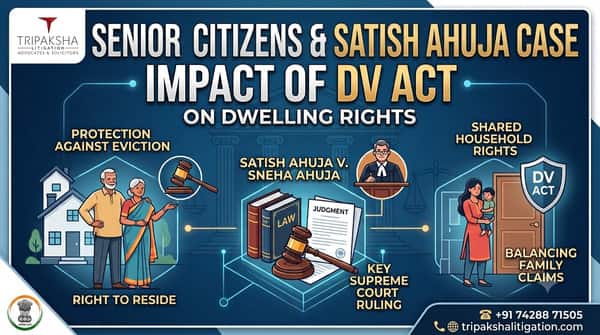
When the Shield Becomes a Sword: The Judgment which cornered India’s Senior Citizens in Their Twilight Years
The golden years of life in a civilized society are meant to be a period of quiet reflection, earned rest, and the comforting security of a home built over decades of relentless toil. For generations, the foundational social contract in India dictated that parents and elders would find shelter, dignity, and care within the family fold. Yet, in the labyrinth of modern matrimonial litigation, this age-old assurance has been steadily dismantled.
At the center of this legal erosion stands a disturbing trend: elderly parents and senior citizens dragged into protracted criminal and civil battlegrounds arising from domestic disputes between their sons and daughters-in-law. Far from being shielded by welfare legislations designed to protect the vulnerable, senior citizens have found themselves increasingly cornered, dispossessed, and exhausted in courtrooms across the country. A major inflection point in this troubling judicial journey is the landmark Supreme Court ruling in Satish Ahuja v. Sneha Ahuja.
While framed in the progressive rhetoric of protecting women’s residence rights under the Protection of Women from Domestic Violence Act (PWDVA) 2005, the practical fallout of the Satish Ahuja precedent has profoundly undermined the statutory rights and peace of mind of senior citizens. It has effectively transformed shared households into arenas of endless litigation, leaving elderly homeowners fighting for the very roof over their heads.
The Promise of Independence vs. The Reality of Litigation
To understand the plight of senior citizens post-Satish Ahuja, one must examine the socio-legal environment they inhabit. Under the Maintenance and Welfare of Parents and Senior Citizens Act 2007, the legislature explicitly sought to protect elderly individuals from neglect, abandonment, and dispossession by family members. The Act recognized that senior citizens possess an absolute right to live in peace in their self-acquired or even ancestral properties, free from intimidation or interference.
However, the intersection of the PWDVA 2005 and property laws—as interpreted and expanded through successive judicial pronouncements, culminating in Satish Ahuja—created a perilous overlap.
In Satish Ahuja, the Supreme Court held that a “shared household” under Section 2(s) of the DV Act is not restricted strictly to a property owned jointly by the husband or taken on rent by him, but can include a household belonging to relatives of the husband—such as parents—where the couple lived together in a domestic relationship. While the Court attempted to balance equities by noting that an aged parent’s right to live peacefully must be factored in, the practical reality inside trial courts and High Courts tells a vastly different story.
In application, the moment an aggrieved daughter-in-law initiates proceedings under the DV Act, the entire household—including aged mothers and retired fathers—is routinely pulled into the legal web. The nuance of “balancing equities” gets lost in the daily grind of interim injunctions, police verifications, and protracted cross-examinations.
The Mechanics of Vulnerability: How Seniors Pay the Price When an elderly citizen’s home is designated as a potential “shared household” subject to claims of residence, the consequences are immediate and severe:
- Loss of Autonomy and Peace in Old Age: A home is not merely bricks and mortar; it is a sanctuary. For a couple in their seventies or eighties, sharing roof space with ongoing, hostile litigation creates an atmosphere of perpetual psychological distress. The home becomes a battleground marked by police visits, notices, and adversarial tension.
- Circumvention of Senior Citizen Tribunals: The 2007 Senior Citizens Act provided a summary procedure for parents to evict abusive or harassing family members and reclaim their properties. However, when civil and criminal courts entertain blanket residence claims under the DV Act involving parental properties, elderly litigants find themselves caught in a jurisdictional tug-of-war. Proceedings under the DV Act drag on for years, rendering summary relief under senior welfare laws practically toothless.
- Financial and Emotional Depletion: Litigation in India is notoriously slow and expensive. Senior citizens, often living on fixed pensions, medical insurance payouts, or depleted savings, are forced to divert their scarce financial resources toward legal representation just to defend ownership of their own homes. The emotional toll of appearing in court alongside allegations of domestic violence—directed not just at the son, but frequently naming elderly in-laws—leaves physical and psychological scars that rarely heal.
- The Presumption of Guilt by Association: In the initial rush of matrimonial complaints, omnibus allegations are routinely leveled against all family members residing under the roof. Even when courts eventually recognize that elderly parents had little to no active role in matrimonial discord, the damage is already done. Months or years have been lost, health has deteriorated, and the fundamental right to a dignified twilight is permanently compromised.
A Reappraisal Long Overdue
The judiciary has, in isolated subsequent rulings, attempted to apply corrective filters—emphasizing that parents cannot be arbitrarily dispossessed of their self-acquired properties, and that elderly individuals have an independent right to a peaceful existence under Article 21 and the Senior Citizens Act. Supreme Court benches have rightly noted that 498A and DV Act proceedings cannot be used as a blunt instrument to harass extended family members or hold senior citizens hostage to settlement negotiations.
Yet, the core structural vulnerability introduced or reinforced by expansive interpretations like Satish Ahuja remains a gaping wound in our jurisprudence.
A legal system that permits the residence rights of one party to override the statutory protection and bodily/mental autonomy of senior citizens in their own twilight years fails the test of balanced equity. The fundamental tenet of justice must recognize that parents who have spent a lifetime securing their independence should not have to spend their final years pleading for it in corridors of law.
Protecting women from genuine domestic deprivation is a constitutional imperative, but it cannot and must not come at the cost of rendering our elderly citizens homeless, helpless, and defenseless in their own homes. It is time for a firm, unambiguous judicial and legislative reaffirmation: an elderly citizen’s right to peace, property, and dignity in old age is absolute, non-negotiable, and superior to peripheral claims in fractured matrimonial disputes.