admin

Can You Sue Police for False Implication Legal Guide 2026
Legal Articles

Can You File A Case Against Police For False Implication? Complete Legal Guide 2026

A person who believes they have been falsely implicated in a criminal case by the police may seek legal remedies to protect their rights and challenge unlawful action. Depending on the circumstances, these may include bail, discharge, quashing of criminal proceedings, complaints to senior police authorities, or approaching the High Court. Evidence such as CCTV footage, digital records, witness statements, and official documents can help establish inconsistencies or misconduct. Where police officers have acted unlawfully, departmental action, criminal proceedings, or compensation may be available, subject to applicable legal requirements.

Can You File A Case Against Police For False Implication? Complete Legal Guide 2026 Read Post »

Delhi High Court Grants Bail in POCSO Case, Treats Surrounding Circumstances as Mitigating Factors
Legal Articles

Delhi High Court Grants Bail in POCSO Case, Treats Surrounding Circumstances as Mitigating Factors

The Delhi High Court granted regular bail in a POCSO case after considering factors including the accused’s young age, the surrounding circumstances of the relationship, and prolonged incarceration. The Court treated these circumstances as relevant mitigating factors while deciding whether continued detention was necessary during the pendency of the trial. The decision illustrates that bail in serious criminal cases requires an individual assessment of the facts, period of custody, progress of the proceedings, and other relevant circumstances. The grant of bail does not determine guilt or innocence, which remains a matter for trial.

Delhi High Court Grants Bail in POCSO Case, Treats Surrounding Circumstances as Mitigating Factors Read Post »

Woman Can Be Charged with Gang Rape Under Section 70 BNS Delhi High Court Holds the Expression “Persons” to Be Gender-Neutral
Legal Articles

Delhi High Court Holds the Expression “Persons” to Be Gender-Neutral

The Delhi High Court has held that a woman can be prosecuted for gang rape under Section 70 of the Bharatiya Nyaya Sanhita, 2023 (BNS) even though the principal offence of rape is defined in gender-specific terms. The Court interpreted the expression “persons” in Section 70 as gender-neutral, meaning liability for participation in a group acting with a common intention is not restricted only to men. The ruling highlights that a person may face gang-rape liability based on their participation and shared intention in the alleged offence, even if they could not individually commit the principal act of rape as statutorily defined.

Delhi High Court Holds the Expression “Persons” to Be Gender-Neutral Read Post »

Can Remarriage Reduce Alimony in India 2026 Legal Guide
Legal Articles

Can A Husband Reduce Alimony After His Ex-Wife Remarries In India? Complete Legal Guide 2026

An ex-wife’s remarriage can affect her right to receive alimony or maintenance in India, but the result depends on the law under which maintenance was granted and the nature of the original court order or settlement. In many situations, continuing maintenance payable to a divorced wife may end or be cancelled after remarriage, while amounts already due or rights created through a final lump-sum settlement may be treated differently. Courts examine the maintenance order, applicable matrimonial law, remarriage, and individual circumstances before modifying or cancelling the obligation.

Can A Husband Reduce Alimony After His Ex-Wife Remarries In India? Complete Legal Guide 2026 Read Post »

Delhi High Court on Maintenance Under Section 125 CrPC Voluntary Retirement
Legal Articles

Delhi High Court on Maintenance Under Section 125 CrPC: Voluntary Retirement

A husband cannot ordinarily avoid his maintenance obligations toward his wife and children merely by taking voluntary retirement or claiming a very small agricultural income. In proceedings under Section 125 CrPC, courts may consider a person’s earning capacity, qualifications, previous employment, assets, lifestyle, and overall financial circumstances rather than relying only on stated current income. The Delhi High Court emphasised that an able-bodied husband has a legal duty to provide maintenance, and voluntarily reducing income cannot automatically defeat a legitimate maintenance claim.

Delhi High Court on Maintenance Under Section 125 CrPC: Voluntary Retirement Read Post »

Shared Household; A Legal Right of Wife
Legal Articles

Shared Household: A Legal Right of Wife?

Under the Protection of Women from Domestic Violence Act, 2005, a wife or woman in a qualifying domestic relationship may have a right to reside in a shared household even without owning the property or having a legal title to it. However, this right is not the same as ownership and depends on the facts of the domestic relationship and residence. Courts may grant residence orders and protection against unlawful dispossession, while balancing these rights with the property rights and circumstances of other family members.

Shared Household: A Legal Right of Wife? Read Post »

Child Custody During Divorce Can You Seek Custody
Legal Articles

Child Custody During Divorce: Can a Parent Seek Custody Before Divorce Is Granted?

During divorce proceedings in India, child custody is decided primarily on the welfare and best interests of the child, rather than an automatic preference for either parent. Courts may grant physical custody, joint or shared parenting arrangements, interim custody, and visitation rights depending on the circumstances. Factors such as the child’s age, emotional needs, education, safety, existing relationship with each parent, stability, and sometimes the child’s own preference can influence the court’s decision.

Child Custody During Divorce: Can a Parent Seek Custody Before Divorce Is Granted? Read Post »

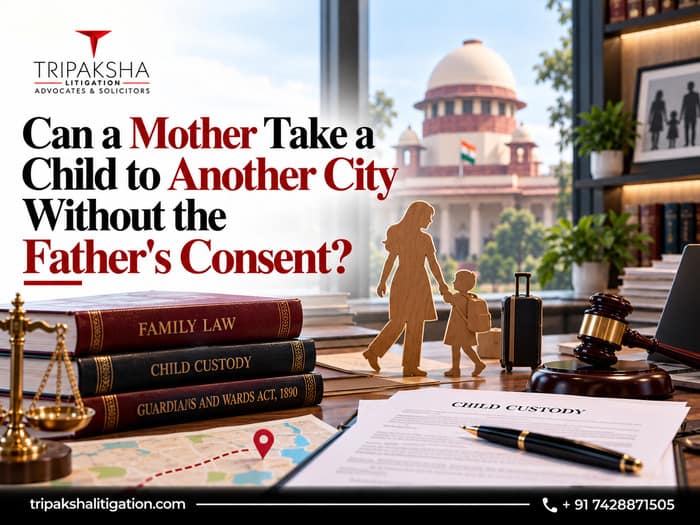
Can a Mother Take a Child to Another City Without the Father's Consent
Legal Articles

Can a Mother Take a Child to Another City Without the Father’s Consent?

A mother in India does not automatically need the father’s consent every time she travels or relocates to another city with the child. Whether relocation is permissible depends on the existing custody arrangement, court orders, visitation rights, and, above all, the child’s welfare and best interests. If a court order restricts relocation or specifies custody and visitation arrangements, it must be followed or modified through the court. Relocation that seriously affects the child’s stability or relationship with the other parent may also lead to a custody dispute.

Can a Mother Take a Child to Another City Without the Father’s Consent? Read Post »

Scroll to Top