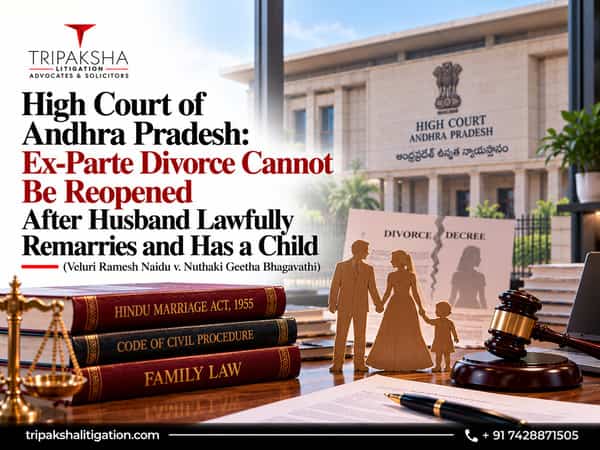
Veluri Ramesh Naidu v. Nuthaki Geetha Bhagavathi
Case Analysis: Ex-Parte Divorce Cannot Be Reopened After Husband Lawfully Remarries and Has a Child
| Case Title | Veluri Ramesh Naidu v. Nuthaki Geetha Bhagavathi |
| Case Number | Civil Revision Petition Nos. 3014 and 3025 of 2025 |
| Court | High Court of Andhra Pradesh |
| Bench | Hon’ble Shri Justice Subba Reddy Satti |
| Date of Order | 27 July 2026 |
| Relevant Provisions | Section 13(1)(ia) and Section 15 of the Hindu Marriage Act, 1955; Order IX Rule 13 and Section 151 of the Code of Civil Procedure, 1908; Section 5 of the Limitation Act, 1963; Article 227 of the Constitution of India |
| Key Precedents Cited | • Krishnaveni Rai v. Pankaj Rai & Ors., (2020) 11 SCC 253 • Anurag Mittal v. Shaily Mishra Mittal, (2018) 9 SCC 691 • Lila Gupta v. Laxmi Narain, (1978) 3 SCC 258 • Surendra Kumar v. Kiran Devi, AIR 1997 Raj 63 • Harjeet Singh v. Guddi, (1987) 1 Raj LR 520 • Judgment of composite AP High Court in C.R.P. No. 2623 of 2009 (decided on 06.08.2009) |
| Final Outcome | Civil Revision Petitions allowed; Trial Court orders condoning delay and setting aside the ex-parte divorce decree set aside; I.A.s dismissed |
Background and Facts of the Case
The petitioner (husband) instituted divorce proceedings under Section 13(1)(ia) of the Hindu Marriage Act, 1955, vide H.M.O.P. No. 34 of 2021 before the Court of Civil Judge (Senior Division), Kavali, Nellore District seeking dissolution of the marriage solemnized on 26.08.2007.
Trial Court Proceedings: Summons was duly served on the respondent (wife), who engaged counsel and filed a vakalatnama on 23.03.2022. The matter was subsequently adjourned on multiple dates (23.03.2022, 28.04.2022, 23.06.2022 and 01.08.2022) for the filing of a counter. On 01.08.2022, counsel of the wife reported “no instructions”, leading the trial court to set her ex-parte. The husband tendered his evidence on affidavit as P.W.1 and marked Exhibits A1 and A2. On 11.08.2022, the trial court granted an ex-parte decree of divorce.
Subsequent Remarriage: The husband waited for approximately five months after the decree. As no appeal was preferred within the statutory limitation period, he lawfully solemnized a second marriage on 11.02.2023 and a female child was subsequently born from this wedlock.
Application to Set Aside Decree: Approximately 680 days after the ex-parte decree, the wife moved I.A. No. 475 of 2024 under Section 5 of the Limitation Act seeking condonation of a 680 day delay along with I.A. No. 17 of 2025 under Order IX Rule 13 CPC to set aside the ex-parte divorce decree. She alleged that her previous advocate colluded with the husband and failed to apprise her of the proceedings.
Trial Court’s Orders: By an order dated 13.02.2025, the trial court allowed the delay condonation application (I.A. No. 475 of 2024) upon payment of ₹680/- costs. Subsequently, on 30.06.2025, it allowed I.A. No. 17 of 2025 upon payment of ₹500/- costs, thereby setting aside the decree of divorce.
Aggrieved by these orders, the husband approached the High Court of Andhra Pradesh under Article 227 of the Constitution of India in Civil Revision Petition Nos. 3014 and 3025 of 2025.
Issues before the High Court
Whether the trial court committed a jurisdictional error and illegality by mechanically condoning an inordinate delay of 680 days without assigning reasoned grounds.
Whether an ex-parte decree of divorce can be set aside under Order IX Rule 13 CPC when the decree-holder has lawfully contracted a second marriage after the expiry of the statutory period of limitation for appeal and a child has been born from the subsequent wedlock.
What is the scope and operation of Section 15 of the Hindu Marriage Act, 1955, where an appeal or application to set aside an ex-parte decree is presented well beyond the prescribed statutory window?
Court’s Analysis and Judicial Reasoning
Mechanical Condonation of Inordinate Delay Without Assigning Reasons Is Unsustainable
The High Court observed that the trial court failed to assign any valid or cogent reasons while condoning the extensive delay of 680 days. Condonation of delay under Section 5 of the Limitation Act cannot be treated as an empty ritual or granted routinely upon the mere payment of nominal costs, particularly when third-party rights and serious altering of legal and civil status have intervened.
Intervening Third-Party Rights: Remarriage and the Status of the Second Spouse and Child
The Court placed reliance on established precedents regarding the profound social and legal consequences of setting aside a divorce decree post-remarriage:
- Citing the composite Andhra Pradesh High Court ruling in C.R.P. No. 2623 of 2009, the Court observed that where a spouse remarries after the marriage has been legally dissolved and begets a child, setting aside the divorce decree unravels that lawful union, stigmatizes the subsequent marriage as illegal/bigamous and prejudices the legitimacy and status of the second wife and child.
- Citing Surendra Kumar v. Kiran Devi (AIR 1997 Raj 63) and Harjeet Singh v. Guddi, the Court emphasized that when a second valid marriage is contracted after the expiry of the limitation period, the interest of the second spouse intervenes, rendering an application under Order IX Rule 13 CPC inequitable and unmaintainable in the interest of justice.
The Statutory Mandate of Section 15 of the Hindu Marriage Act, 1955
The High Court examined the Supreme Court’s authoritative ruling in Krishnaveni Rai v. Pankaj Rai & Ors. (2020) 11 SCC 253:
- Protection of Section 15: Section 15 permits remarriage after dissolution of marriage if there is no right of appeal against the decree, or where the right to appeal exists, the statutory period of limitation has expired without an appeal being presented. The statutory bar applies strictly when an appeal is presented within the limitation period.
- Incapacity and Condonation: The Supreme Court affirmed that the statutory bar under Section 15 cannot operate against a party who has lawfully remarried upon the expiry of the limitation period, even if an application for condonation of delay is preferred subsequently.
Consequently, once a party contracts a valid remarriage following the lapse of the prescribed period without any subsisting appeal or interim stay, the proceedings seeking to reopen or challenge the divorce decree become infructuous for all practical purposes.
Failure of Jurisdiction Resulting in Travesty of Justice
The High Court held that the trial court failed to exercise its jurisdiction properly by completely overlooking the binding principles of the Apex Court and other High Courts. Leaving the trial court’s orders undisturbed would result in a severe travesty of justice for the second spouse and the minor child born from the valid second wedlock.
Legal Principles Emerging from the Judgment
- An ex-parte divorce cannot be set aside under Order IX Rule 13 once the spouse lawfully remarries after the appeal period expires.
- The remarriage bar ends once the limitation period lapses; subsequent delay condonation does not invalidate the second marriage.
- Courts must protect the legal legitimacy and rights of the second spouse and minor child.
- Long delays cannot be condoned routinely on nominal costs without sound reasoning.
- The first wife remains free to pursue separate statutory maintenance claims.
Significance of the Judgment
- Prevents Order IX Rule 13 CPC from being misused to disturb settled marital status long after the statutory appeal window expires.
- Safeguards the validity of subsequent lawful marriages and protects the legitimacy of children born from them.
- Bars trial courts from condoning long delays mechanically without recording reasoned grounds.
- Affirms that procedural recall under the CPC cannot override the substantive statutory protections of Section 15 of the Hindu Marriage Act, 1955.
Final Decision
- The High Court allowed Civil Revision Petition Nos. 3014 and 3025 of 2025.
- The trial court’s orders condoning the 680-day delay (I.A. No. 475/2024) and setting aside the ex-parte divorce decree (I.A. No. 17/2025) were set aside and both applications were dismissed.
- The Court clarified that the wife remains free to pursue independent statutory maintenance claims.
Conclusion
This ruling reconciles procedural fairness with substantive justice by confirming that an ex-parte divorce decree cannot be reopened once a party lawfully remarries after the appeal period expires. Upholding the trial court’s order would have caused grave injustice by rendering a valid second marriage illegal and delegitimizing an innocent child. By dismissing the unreasoned applications while preserving the estranged wife’s statutory relief, the High Court reaffirmed the finality intended under Section 15 of the Hindu Marriage Act.
Written By: Adv. Vibhuti Zibbu
Date: 24-Oct-2026